How Long Does It Take to Delete a 6.7 Powerstroke? A Complete Time Guide
If you’re a Ford Super Duty owner, you’ve probably asked yourself: "How long is my truck going to be out of commission if I decide to delete it?"
It’s a fair question. Whether you're tired of the constant "Exhaust Filter Full" messages or you're looking to unlock that hidden 6.7L engine potential, time is money. As a tech here at SPEtuner, I've seen guys knock this out in a Saturday morning, and I've seen others spend three days fighting a single rusted bolt.
In this guide, I’m going to give you the honest, grease-under-the-fingernails truth about how long this process actually takes.
Quick Answer: Average Time to Delete a 6.7 Powerstroke
If you want the "Too Long; Didn't Read" version, here it is:
On average, a full delete (DPF and EGR) on a 6.7 Powerstroke takes 6 to 12 hours for a DIYer with decent tools. If you take it to a professional performance shop, they can usually wrap it up in 4 to 6 hours, though most will ask you to leave the truck for a full day. If you are still in the planning phase, you might want to read up on what is required for this process before clearing your weekend schedule.
DIY Installation Time (4–8 Hours)
If you have a lift, air tools, and a buddy who knows his way around a wrench, you can hit the lower end of this spectrum. However, if you are working on your back in a driveway with basic hand tools, plan for a full 8-hour shift—or a whole weekend just to be safe.
Professional Shop Installation Time (1 Day / 4-6 Hours)
Pros have the advantage of repetition. They know exactly which 13mm bolt is going to snap and how to wiggle the EGR cooler out without removing the cab. While the actual "wrench time" is about 5 hours, shops factor in "buffer time" for PCM flashing and cooling system pressure tests.
Step-by-Step Breakdown of the 6.7 Powerstroke Delete Process
To understand why it takes this long, we need to look at the four distinct phases of the job.
Phase 1: Preparation and ECM Tuning (1-2 Hours)
Never touch a wrench until you’ve touched the tuner. This is the golden rule at SPEtuner.
Gathering Necessary Tools and Safety Setup
Spend 30 minutes organizing your workspace. You’ll need plenty of penetrating oil (like PB Blaster), a 10mm-15mm socket set, and a sturdy jack.
Flashing the ECM with a Custom Delete Tune
Before removing a single pipe, you must flash your truck’s computer (ECM) with a compatible programming device. Selecting and choosing the appropriate tuning device is critical.
Why? If you remove the hardware first, the truck will enter "Limp Mode" immediately.
Time Tip: Flashing can take 15 to 45 minutes depending on the device. Do this first so you know the software is "married" to the truck successfully.
Phase 2: DPF and DEF System Removal (2-3 Hours)
This is the "heavy lifting" part of the project. You’ll be removing the Diesel Particulate Filter (DPF) and the Selective Catalytic Reduction (SCR) assembly.
Disconnecting Sensors and DEF Lines Safely
There are several EGT (Exhaust Gas Temperature) sensors and NOx sensors plugged into the exhaust. Disconnect these carefully. You don't want to snap the wiring harness.
Dropping the Heavy DPF/SCR Assembly
The factory exhaust is heavy—nearly 80-100 lbs. Use a floor jack to support it. Once the flanges are unbolted, you’ll likely need a pry bar to pop the rubber hangers.
Phase 3: EGR Cooler and Valve Delete (3-5 Hours)
Ask any mechanic: This is the hardest part. The Exhaust Gas Recirculation (EGR) system is tucked into the engine bay, and it's a tight squeeze.
Removing the Factory 6.7 EGR Components
You’ll be dealing with many small bolts, some of which are located behind the intake manifold. This requires patience and small hands.
Installing Block-Off Plates and Rerouting Coolant Lines
Once the cooler is out, you must install plates to seal the exhaust manifold and intake. For a closer look at this complex step, check out the detailed steps for cooler removal. You also have to reroute the coolant lines that used to flow through the cooler.
Pro Tip: This is where leaks happen. Ensure your gaskets are seated perfectly. If you rush this, you’ll spend another 3 hours fixing a coolant leak tomorrow.
Phase 4: Installing the New Exhaust Delete Pipe (1-2 Hours)
The "fun" part. You’re finally putting the new, high-flow parts on.
Fitting the DPF Delete Pipe and Aligning Exhaust Hangers
The new pipe is much lighter and easier to handle than the stock one. Slide it into the factory hangers and bolt it to the downpipe. If you are unsure about the sizing, understanding the differences in exhaust diameters can help you align everything perfectly.
Final Checks and Starting the Engine
Check your fluid levels (especially coolant if you did the EGR delete). Start the engine and listen for exhaust leaks. If all sounds good, take it for a slow test drive to let the tuner calibrate.
Key Factors That Affect Your Installation Time
Not every 6.7 Powerstroke is created equal. Here is why your buddy’s truck took 4 hours and yours is taking 10.
Mechanic Experience Level (Beginner vs. Expert)
If this is your first time seeing a DPF, you’re going to spend a lot of time watching YouTube videos mid-install. An expert knows the "shortcuts" (like which sensors can be cut vs. unplugged).
Truck Model Year Variations
2011-2014: Generally the easiest. The engine bay layout is slightly more forgiving.
2015-2019: Moderate. Minor changes in sensor locations and turbo plumbing.
2020+: These take the longest. Ford tightened up the engine bay, and the ECM encryption is much harder to bypass, often requiring an "unlock" process that adds 1-2 hours to Phase 1.
Rust, Corrosion, and Stubborn Exhaust Bolts
If you live in the "Salt Belt" (Ohio, New York, Canada), your exhaust bolts are essentially welded shut by rust. A "10-minute" bolt can easily become a "2-hour" drilling project. Use penetrating oil 24 hours before you start.
Scope of the Project (Full Delete vs. Partial)
Are you just doing a DPF delete pipe? That’s a 3-hour job. Are you doing a full EGR delete, a cold air intake, and a CCV reroute? Now you’re looking at a 10-12 hour marathon. To save time hunting for individual parts, using an integrated hardware package is the smartest route.
- For 2011-2019 Owners: The 6.7L Powerstroke All-in-One Delete Kit provides every exact-fit component in a single box, cutting hours off your installation time.
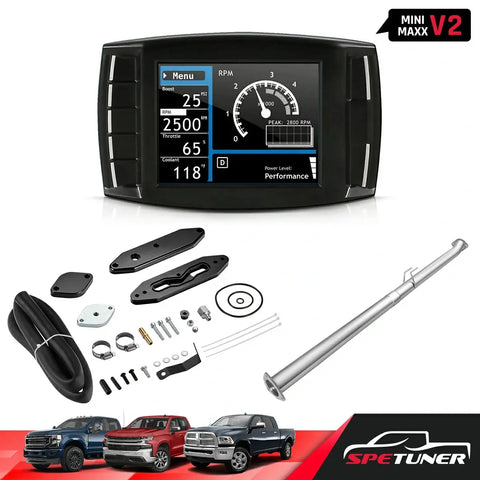
Upgrade your 2011–2019 Ford F250 or F350 with our most comprehensive emissions delete package. This complete kit includes a Mini Maxx V2 Tuner, a 4" DPF delete race pipe, EGR block-off plates, and a DEF bypass module. Engineered to unlock maximum horsepower, improve fuel economy by up to 15%, and extend your engine's durability.
- For 2020-2025 Owners: The engine bay is much tighter, which is why the 2020-2025 6.7L Powerstroke All-in-One Kit is engineered specifically to bypass the newer complex systems seamlessly.
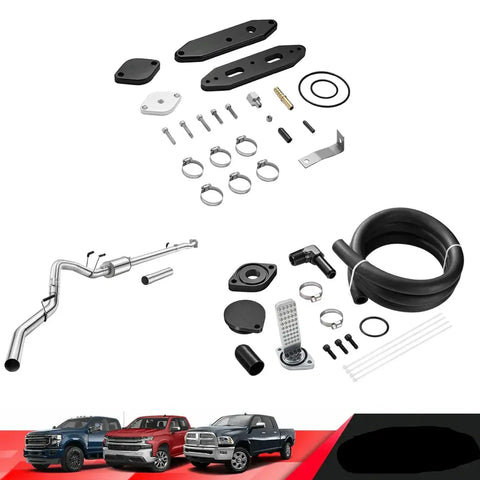
Enhance your newer 6.7L Powerstroke's performance by reducing harmful deposits and optimizing airflow. This integrated package includes a DPF delete pipe, a complete EGR removal kit, and a CCV reroute with an internal catch can. Prevent oil sludge buildup, extend turbo life, and experience crisper throttle response and better fuel mileage.
Essential Tools You Need to Speed Up the Job
To make sure you aren't stuck in the garage forever, you need the right gear. Check out our comprehensive overview of the 6.7 modification for a deep dive into specific tools.
Standard Mechanic Tools
- Metric socket set (deep and shallow).
- Torque wrench (critical for the EGR block-off plates).
- Long reach needle-nose pliers.
Specialty Tools and Penetrating Oil
- PB Blaster or WD-40 Specialist: Spray everything the night before.
- Exhaust Hanger Removal Tool: This will save your knuckles and about 45 minutes of struggling with rubber grommets.
Is Deleting Your 6.7 Powerstroke Worth the Time?
Is a full Saturday of work worth it? Let’s look at the ROI (Return on Investment).
Massive Gains in Horsepower and Torque
A standard "Tow" tune can add 50-100 HP. A "Race" tune? You’re looking at an extra 150+ HP and a massive bump in torque that you’ll feel the second you hit the pedal.
Better Fuel Economy (2-5 MPG Increase)
The DPF "regen" cycle literally sprays extra diesel into your exhaust to burn off soot. By deleting it, you stop wasting fuel, which leads to a direct impact on fuel efficiency. Most of our customers report a 2-4 MPG improvement instantly.
Improved Long-Term Engine Reliability
No more soot being recirculated into your intake. No more heat buildup in the DPF. When comparing the long-term engine reliability differences, modified trucks generally breathe cleaner, run cooler, and last longer.
Conclusion: Get the Right 6.7 Powerstroke Delete Kit Today
Timing is everything. If you want a smooth, fast installation, you need hardware that actually fits. Don’t settle for "universal" parts that require cutting and welding.
At SPEtuner, we specialize in high-quality performance parts. You can browse our complete line of 2011-2019 6.7L Powerstroke performance parts or our newer 2020+ 6.7L Powerstroke performance parts. Our Powerstroke Delete kits collections include everything you need to get the job done right the first time.
Frequently Asked Questions (FAQs)
Q1: Can I drive my 6.7 Powerstroke without a tune after a delete?
A1: Absolutely not. If you remove the DPF without a tune, the sensors will detect zero backpressure, and the truck will enter "Limp Mode," limiting you to about 5 mph. Always install the tune first.
Q2: How hard is it to delete a 6.7 Powerstroke by yourself?
A2: On a scale of 1 to 10, it's a 7. The exhaust is just heavy, but the EGR delete is technically challenging due to the tight space. If you can change your own brakes and oil, you can likely do a delete.
Q3: How much does a shop charge to delete a 6.7 Powerstroke?
A3: Labor rates vary, but expect to pay between $600 and $1,200 for labor alone, depending on your location and whether you are doing a full EGR delete.
Q4: Do I need to drain the coolant for an EGR delete?
A4: Yes. Since the EGR cooler uses engine coolant, you will need to partially drain the system. Make sure to have fresh Motorcraft specialized coolant ready to refill it.
Q5: Will deleting void my warranty?
A5: In most cases, yes. Any modification to the emissions system typically voids the powertrain warranty. It’s important to research the potential drawbacks and warranty considerations before starting.
Q6: What is the most time-consuming part of the job?
A6: The EGR cooler removal. The bolts at the back of the cooler are notoriously difficult to reach and often require a variety of extensions and swivels.
Q7: Can I do a DPF delete but leave the EGR in place?
A7: Yes, this is called a "DPF-only delete." For a deeper understanding of partial exhaust modifications, this route is much faster (2-4 hours) but doesn't provide the full reliability benefits of removing the soot-clogging EGR system.
Q8: Does a delete make the truck much louder?
A8: If you keep the stock muffler, the change is subtle. If you install a straight pipe, your 6.7 will have that classic deep diesel growl and a much more noticeable turbo whistle.
Q9: How can I prevent snapping exhaust bolts?
A9: Heat and lubrication. Use a torch to heat stubborn nuts and soak them in penetrating oil. If a bolt feels "spongy," stop turning and apply more oil.
Q10: Should I buy a specialized delete kit or piece it together?
A10: Buy a kit. Piecing it together often leads to missing gaskets or mismatched pipe diameters, which can turn a 6-hour job into a 3-day nightmare.