6.7 Powerstroke DPF and EGR Delete: Complete 2026 Guide
Quick Answer: A 6.7 Powerstroke delete kit removes or bypasses emissions parts such as the DPF, EGR, DEF/SCR system, and related sensors. The goal is to reduce exhaust restriction, stop frequent regen cycles, lower EGTs, and improve reliability for off-road, racing, farm, or competition use.
But it is not right for every truck. If your F-250 or F-350 is still used on public roads, under warranty, or registered in an emissions-testing state, you need to understand the legal, warranty, and inspection risks before buying any delete kit.
Important Legal Note: This article is for education and off-road/racing use information only. Removing or disabling emissions equipment may be illegal on vehicles used on public roads. Laws vary by location. Always check federal, state, and local rules before modifying your truck.
The 6.7 Powerstroke is one of Ford’s strongest diesel engines. It can tow hard, make serious torque, and last a long time when maintained well. But many owners run into the same problems as miles add up: clogged DPF filters, failed EGR coolers, DEF faults, frequent regen cycles, high EGTs, and poor fuel economy when towing.
This guide explains how the DPF and EGR systems work, when a delete kit may make sense, when it does not, what parts are required, and how to choose the right setup for your 2011-2024+ Ford 6.7 Powerstroke.
Should You Delete a 6.7 Powerstroke?
A delete may make sense only if your truck is used for off-road, racing, farm, or private-property applications and you fully understand the legal risk. From a mechanical point of view, the strongest reasons are repeated DPF failure, heavy towing, high EGTs, oil dilution from frequent regen, or expensive DEF/EGR repairs.
| Your Situation | Delete May Make Sense? | Better First Step |
|---|---|---|
| Truck is used on public roads every day | No, high legal and inspection risk | Repair, clean, or maintain emissions system |
| Truck is under factory warranty | Usually no | Use dealer diagnosis and warranty repair |
| Frequent regen every 100-200 miles | Possible, for off-road use only | Scan DPF pressure, check injectors, clean DPF |
| EGR cooler leaking coolant | Possible, for off-road use only | Stop driving and repair before engine damage |
| Heavy towing on private land, farm, or race use | Yes, if legal for your use case | Choose a tow-safe tune and monitor EGT |
| Low-mileage truck with no codes | Usually no | Keep maintenance up to date |
What Is a 6.7 Powerstroke Delete Kit?
A 6.7 Powerstroke delete kit is a group of parts used to remove or bypass factory emissions equipment. Depending on the kit, it may include a DPF delete pipe, EGR delete parts, DEF/SCR delete parts, block-off plates, coolant reroute parts, sensor solutions, and a tuner.
The tuner is not optional. If the truck’s computer is not programmed correctly, the truck may go into limp mode, show check engine lights, or run poorly.
Main Parts in a Complete Delete Setup
- DPF delete pipe: Replaces the diesel particulate filter section with a straight-through pipe.
- EGR delete kit: Blocks or removes exhaust gas recirculation parts and reroutes coolant where needed.
- DEF/SCR delete parts: Used on trucks with DEF and SCR systems.
- Tuner/programmer: Changes ECU strategy so the truck can run without the removed emissions parts.
- Hardware: Gaskets, clamps, bolts, block-off plates, and fittings.
How the 6.7 Powerstroke Emissions System Works
Before deciding anything, it helps to know what you are removing. Ford designed the DPF, EGR, DOC, SCR, and DEF systems to reduce soot and NOx emissions. These systems work, but they also add heat, backpressure, sensors, and service cost.

DPF: Diesel Particulate Filter
The DPF traps soot from the exhaust. When soot builds up, the truck starts a regeneration cycle. During regen, exhaust temperature rises so the soot can burn off.
That process is normal, but it can become a problem when the truck does a lot of short trips, idling, city driving, job-site use, or heavy towing. The DPF may not get hot enough for passive regen, so the truck forces active regen more often.
EGR: Exhaust Gas Recirculation
The EGR system sends some exhaust gas back into the intake. This lowers combustion temperature and reduces NOx emissions. The downside is that soot, oil vapor, and heat can build carbon inside the intake system over time.
Common EGR-related issues include stuck EGR valves, plugged coolers, coolant loss, rough idle, black smoke, and power loss.
DEF and SCR
The DEF/SCR system helps reduce NOx after combustion. It uses diesel exhaust fluid and several sensors. When the system fails, many owners see warning messages, countdowns, limp mode, or expensive repair bills.
Common Signs Your DPF or EGR System Has Problems
Not every check engine light means you need a delete. Use the symptoms below as a starting point, then confirm with scan data before spending money.
DPF Problem Symptoms
- Regen happens too often, such as every 100-200 miles.
- “Cleaning exhaust filter” messages appear often.
- The truck loses power when towing.
- Fuel economy drops by 2-4 MPG.
- The truck enters limp mode under load.
- Oil smells like diesel fuel.
- DPF-related codes return after clearing.
Common DPF Codes
| Code | Meaning | Likely Cause |
|---|---|---|
| P2002 | DPF efficiency below threshold | Clogged, cracked, or failing DPF |
| P242F | DPF ash accumulation | High ash load, cleaning or replacement needed |
| P2463 | DPF soot accumulation | Failed or incomplete regen |
| P2453 | DPF pressure sensor range | Bad sensor, wiring issue, or heavy restriction |
| P20EE | SCR NOx catalyst efficiency | DEF/SCR system fault |
EGR Problem Symptoms
- Rough idle or engine shake.
- Lazy throttle response.
- Black smoke during acceleration.
- Coolant loss with no visible leak.
- White smoke from the exhaust.
- EGR codes such as P0401, P0402, P0403, or P0404.
Warning: If you see thick white smoke, smell coolant, or notice sudden coolant loss, stop driving. A failed EGR cooler can lead to overheating or engine damage.
Try These Alternatives Before Deleting
A good diesel owner does not throw parts at the truck blindly. Before deleting, check whether a repair or maintenance step can solve the problem.
1. Professional DPF Cleaning
A shop can remove the DPF and clean it with heat and air pressure. This may restore flow if the filter is not cracked or too full of ash.
- Best for: trucks that still need emissions compliance.
- Typical cost: $300-$600.
- Limitation: It may not fix the root cause if the truck creates too much soot.
2. Fix Excessive Soot Production
If the truck clogs the DPF too fast, the DPF may not be the real problem. Check injectors, turbo boost, air filter condition, EGR valve position, and fuel quality.
3. Improve Regen Conditions
Short trips are hard on a DPF. A weekly 30-40 minute highway drive can help some trucks complete passive regen. This is not a cure for a damaged DPF, but it can help a healthy system last longer.
4. Clean the EGR System
If the EGR valve or intake has heavy carbon, cleaning may restore airflow and reduce rough idle. This is a better option if the truck must stay emissions-compliant.
When a Delete Kit Makes the Most Mechanical Sense
High-Mileage Trucks With Repeated DPF Failure
If your truck has more than 120,000 miles, repeated DPF codes, and failed cleaning attempts, the stock emissions system may be near the end of its useful life. OEM DPF replacement can cost thousands of dollars.
Heavy Towing and Work Trucks
Heavy towing creates heat. A restricted DPF adds backpressure and can raise EGT. For off-road or private-property work trucks, a delete and tow tune can reduce heat and make the truck feel less choked under load.
Farm, Ranch, Racing, and Private-Property Use
Low-speed work, long idle time, dust, and stop-and-go operation are hard on emissions systems. Trucks used only off-road or on private property may benefit from a simpler exhaust path, if the modification is legal for that use.
Benefits of Deleting a 6.7 Powerstroke
The benefits depend on the truck, tune, driving style, and hardware quality. Do not expect every truck to gain the same results.
| Benefit | Why It Happens | Typical Result |
|---|---|---|
| Lower EGT | Less exhaust restriction | Often 150-300°F lower under load |
| Better throttle response | Turbo can spool with less backpressure | Quicker response, less lag |
| Better MPG | No active regen fuel use and less pumping loss | Often 1-4 MPG, depending on use |
| Less oil dilution | No post-injection regen cycle | Cleaner oil over time |
| Lower repair cost | Fewer emissions parts to fail | Less DPF, DEF, and EGR maintenance |
Horsepower Gains: Delete Only vs Delete With Tune
The delete hardware alone is not where most power comes from. The tune unlocks the power by changing fueling, timing, boost control, and torque management.
| Setup | Estimated HP Gain | Best Use |
|---|---|---|
| Delete pipe only, no proper tune | Not recommended | Can cause codes or limp mode |
| Delete + economy/tow tune | +30 to +80 HP | Towing, daily use, lower EGT |
| Delete + street tune | +80 to +120 HP | Empty driving and throttle response |
| Delete + race tune | +150 HP or more | Competition use only |
Towing Warning: Do not tow heavy on a race tune. Use a tow tune, watch EGT, and keep transmission temperature under control.
How to Choose the Right 6.7 Powerstroke Delete Kit
The right kit depends on your model year, current problem, budget, and whether you already own a tuner.
Option 1: EGR Delete Kit Only
Best for: owners fixing EGR cooler or valve issues on off-road trucks.
- Lower cost than a full kit.
- Does not solve DPF regen problems.
- May still require tuning, depending on setup.
Option 2: DPF Delete Pipe Only
Best for: owners who already have tuning and need the exhaust hardware.
- Improves exhaust flow.
- Does not include EGR parts.
- Not enough by itself for a complete setup.
Option 3: Full Delete Kit Without Tuner
Best for: owners who already have a compatible tuner and delete files.
- Usually includes DPF pipe, EGR parts, hardware, and sensor solutions.
- Good value if tuning is already handled.
- Risky if tuner compatibility is not confirmed first.
Option 4: All-in-One Delete Kit
Best for: first-time buyers who want matched parts in one package.
- Includes hardware and tuner.
- Reduces mismatch problems.
- Best choice when you want a clear install path.
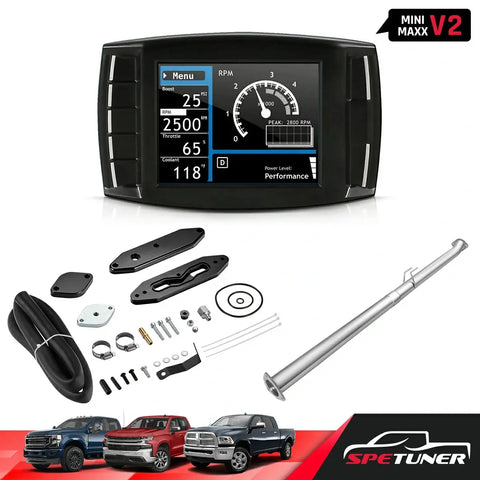
This all-in-one setup is built for off-road 2011-2019 6.7 Powerstroke owners who want matched parts, simple ordering, and a clear install path. It includes the key hardware needed to remove the most restrictive factory emissions parts.
Shop This KitModel Year Compatibility Guide
Always verify the exact year, engine, cab style, emissions layout, and tuner support before buying. A kit that fits one 6.7 Powerstroke generation may not fit another.
| Model Year | What to Know | Buying Tip |
|---|---|---|
| 2011-2014 | Earlier emissions layout and easier tuning support. | Confirm pipe length and tuner file support. |
| 2015-2016 | Updated sensors and hardware changes. | Use a kit listed for 2015+ trucks. |
| 2017-2019 | More monitoring and tighter ECU strategy. | Choose a proven tuner and matched hardware. |
| 2020-2024+ | More complex ECU and emissions control strategy. | Do not assume older kits will fit or tune correctly. |
Browse related kits here: 6.7 Powerstroke Delete Kits, Powerstroke EGR Delete Kits, Powerstroke DPF Delete Kits, and Tuners & Programmers.
4-Inch vs 5-Inch Exhaust: Which One Should You Choose?
Most 6.7 Powerstroke owners are fine with a 4-inch delete pipe or exhaust. It flows well, fits easier, and keeps sound more controlled. A 5-inch exhaust is louder and may help high-power builds, but it is not required for most tow setups.
| Exhaust Size | Best For | Sound |
|---|---|---|
| 4-inch | Daily use, towing, work trucks | Deep but controlled |
| 5-inch | Performance builds, louder sound, higher flow goals | Louder and deeper |
Installation Overview
Installation difficulty is moderate for an experienced DIY owner. If you are not comfortable working under the truck, draining coolant, or flashing an ECU, use a qualified diesel shop.
Basic Install Steps
- Park the truck safely and disconnect the battery if required.
- Raise and support the truck with proper stands.
- Remove the factory DPF/DOC section.
- Install the delete pipe and check all clamps and hangers.
- Drain coolant if the EGR cooler is being removed or bypassed.
- Install EGR block-off plates and coolant reroute parts.
- Connect the tuner and load the correct file.
- Start the truck and check for leaks, codes, and abnormal sounds.
- Test drive and monitor EGT, boost, coolant temp, and transmission temp.
Install Time
- Experienced DIY owner: 3-5 hours.
- First-time DIY owner: 5-8 hours.
- Diesel shop: usually faster, depending on rust and model year.
Tuning After Delete
The tune controls how the truck drives after the delete. Do not pick the hottest tune just because the number looks good. The safest tune depends on how you use the truck.
Tow Tune
Best for towing, hauling, long trips, and work use. It focuses on lower EGT, safer torque delivery, and better shift behavior.
Street Tune
Best for unloaded driving and better throttle response. It can feel strong without being as aggressive as a race tune.
Race Tune
Best for competition use only. It can create high cylinder pressure, high EGT, and extra drivetrain stress. Do not use it while towing.
Maintenance After Deleting
A deleted off-road truck still needs maintenance. In fact, you should monitor it more closely because the engine can make more power and torque than stock.
- Change oil on time, especially if towing often.
- Replace fuel filters regularly.
- Check exhaust clamps after heat cycles.
- Watch EGT, boost, coolant temperature, and transmission temperature.
- Keep tuner files and device information backed up.
- Inspect for coolant leaks after any EGR-related work.
Common Mistakes to Avoid
- Buying parts before checking local laws: This can create legal and inspection problems.
- Using the wrong tune: A bad tune can hurt the engine or transmission.
- Towing on a race tune: This is one of the fastest ways to create high EGT.
- Buying a universal kit: Model year fitment matters on the 6.7 Powerstroke.
- Ignoring scan data: Diagnose the real problem before deleting or replacing parts.
- Using cheap exhaust parts: Poor welds, thin pipe, and bad flanges can leak or crack.
Final Verdict: Is a 6.7 Powerstroke Delete Worth It?
For a public-road daily driver, a delete is usually not the right answer because of legal, inspection, and warranty risk. For an off-road, race, farm, or private-property 6.7 Powerstroke with repeated emissions failures, a complete delete kit with proper tuning can reduce restriction, lower EGTs, stop regen issues, and simplify long-term maintenance.
The best setup is not always the most aggressive one. Most owners who tow or work their trucks should choose a matched kit, a conservative tow tune, quality stainless exhaust parts, and proper monitoring.
Need a simple place to start?
Check your truck’s model year, confirm your use case, then browse the correct Powerstroke category before choosing parts.
Frequently Asked Questions
Q1: What does a 6.7 Powerstroke delete kit do?
A 6.7 Powerstroke delete kit removes or bypasses emissions parts such as the DPF, EGR, DEF/SCR system, and related sensors. It is mainly used for off-road, racing, farm, or private-property trucks.
Q2: Is deleting a 6.7 Powerstroke legal?
It can be illegal on vehicles used on public roads. Laws vary by location, and emissions rules can be strict. Always check the rules in your area before modifying the truck.
Q3: How much horsepower does a 6.7 Powerstroke delete add?
The hardware alone does not add much power. Most gains come from tuning. A tow tune may add 30-80 HP, while more aggressive tunes can add more. Use the right tune for your truck’s job.
Q4: Will a delete improve fuel economy?
Many owners report better fuel economy because the truck no longer uses fuel for active regen and has less exhaust restriction. A realistic range is often 1-4 MPG, depending on driving style, load, tune, and truck condition.
Q5: Can I delete my truck without a tuner?
No. A proper tuner is required. Without correct tuning, the truck may show check engine lights, enter limp mode, or run poorly.
Q6: What is the best tune for towing?
A tow or economy tune is the best choice for towing. It keeps power controlled, helps manage EGT, and supports safer transmission behavior.
Q7: Can I tow with a race tune?
No. Race tunes are not safe for heavy towing. They can create high EGT and high cylinder pressure under sustained load.
Q8: Will deleting void my warranty?
It can affect warranty coverage, especially for engine, emissions, and powertrain claims. If your truck is under warranty, think carefully before modifying it.
Q9: Can I return a deleted 6.7 Powerstroke back to stock?
It may be possible if you kept all factory parts and the truck can be flashed back to a stock file. But returning to stock can be costly, and some inspection or warranty issues may still remain.
Q10: What should I check before buying a delete kit?
Confirm your model year, emissions layout, cab and bed configuration, tuner compatibility, local laws, and intended use. Also decide whether you need an EGR-only kit, DPF pipe, full kit, or all-in-one package.

Lars
Diesel Performance Engineer | 15+ Years EXPERIENCE
"Empower Your Beast: Run Cooler, Pull Harder, Last Longer."