4-Inch vs. 5-Inch Exhaust for 6.7 Powerstroke: Which is Better?
For 2011–2019 Ford 6.7L Powerstroke owners, choosing the correct exhaust diameter after a delete is one of the most misunderstood decisions in the diesel world. Internet advice often reduces the discussion to “bigger pipe = more power”, but real-world results—especially for towing and daily driving—tell a very different story. Understanding the mechanics of diesel truck deletion helps clarify why bigger isn't always better.
⚡ Quick Verdict
- A 4-inch exhaust delete kit is the optimal choice for the vast majority of 6.7 Powerstroke trucks—daily drivers, work trucks, and tow rigs—because it balances exhaust velocity, sound control, and fitment.
- A 5-inch system is best reserved for high-horsepower builds, show trucks, or race-oriented setups where sound and peak airflow matter more than comfort.
Both systems dramatically outperform the restrictive factory DPF/CAT assembly. The correct choice depends entirely on how your truck is used, not on forum hype. Below is a technical, experience-based breakdown designed to help you choose correctly the first time.
Why Exhaust Diameter Matters on a VGT Diesel
The 6.7L Powerstroke uses a Variable Geometry Turbocharger (VGT), which fundamentally changes how exhaust size affects performance. Unlike older fixed-geometry turbos, a VGT actively controls exhaust backpressure to improve low-end torque and spool.
This means exhaust velocity—not just volume—is critical. Oversizing the exhaust can reduce low-RPM gas speed, which offers no benefit on a stock or mildly tuned truck because the turbo is not airflow-limited.
In practical terms, once the restrictive DPF is removed, the factory turbo outlet becomes the limiting factor—not the exhaust pipe diameter.
Key Differences Comparison: 4-Inch VS. 5-Inch Exhaust Systems
1. Horsepower & EGTs (Exhaust Gas Temperatures)
Many owners expect a noticeable horsepower gain by jumping from a 4-inch to a 5-inch pipe. On a stock-turbo 6.7 Powerstroke, this expectation is rarely met.
- 4-Inch Performance: Easily supports stock and tuned applications up to ~600–650 HP. Maintains higher exhaust gas velocity, which improves turbo response, drivability, and towing manners. EGTs typically drop 200–300°F compared to stock.
- 5-Inch Performance: Offers slightly better heat dissipation at sustained wide-open throttle. Required only for builds exceeding 700–900 HP. However, on a factory turbo, dyno differences are often under 5 HP. The advantage only becomes meaningful on large single-turbo or compound setups.
Bottom line: If you are not airflow-limited by upgraded turbos and fuel, a 5-inch pipe does not unlock hidden power.
2. Sound Characteristics: Tone, Volume, and Drone
Sound is the primary reason most owners regret—or praise—their exhaust choice.
- 4-Inch Sound Profile: Crisp and controlled. Emphasizes turbo whistle and higher-frequency exhaust notes. A drone is extremely rare, even when towing at highway speeds. Ideal for long trips, family use, and work trucks.
- 5-Inch Sound Profile: Deep, hollow, and aggressive at idle and acceleration. The larger diameter produces lower-frequency sound waves, which are far more likely to resonate with the Super Duty cabin—especially between 1,800–2,000 RPM.
On crew cab trucks that tow heavy loads, this resonance often occurs during sustained highway pulls, leading to fatigue on long drives.
3. Installation & Fitment
Under-chassis space on a Ford Super Duty is limited, particularly near the rear axle and spare tire.
- 4-Inch Fitment: Follows factory routing closely. Clears shocks, track bar, and spare tire without modification. True bolt-on installation.
- 5-Inch Fitment: Tight clearances near the spare tire and heat shields. Some installs require repositioning the spare tire, bending heat shields, or extended alignment time to prevent rattles.
Comparison at a Glance
| Category | 4-Inch Exhaust | 5-Inch Exhaust |
|---|---|---|
| Best Use Case | Daily driving, towing, work trucks | High-HP builds, show trucks, racing |
| Sound | Crisp, turbo-forward | Deep, aggressive rumble |
| Drone Risk | Very low | High at highway RPM |
| Installation | Simple bolt-on | Moderate difficulty |
| Power Support | Up to ~650 HP | 900+ HP capable |
Material Selection: Aluminized vs. Stainless Steel
Pipe diameter is only part of the decision—material choice affects longevity. Reviewing our cost analysis of diesel truck components can help you decide if the stainless upgrade is worth it.
- Aluminized Steel: Cost-effective and suitable for dry climates. Expect surface corrosion over time in northern or coastal regions.
- T409 Stainless Steel: Superior corrosion resistance and structural longevity. Develops a cosmetic patina but will not rust through. Strongly recommended for long-term ownership.
Choosing the Right Setup for Your Truck
| Your Usage | Recommended Exhaust |
|---|---|
| Weekly towing (8,000–15,000 lbs) | 4-Inch |
| Daily highway driving | 4-Inch |
| Upgraded turbo / race build | 5-Inch |
| Show truck / sound priority | 5-Inch |
Once you've decided on the diameter that fits your driving style, the next step is securing high-quality Ford 6.7 Powerstroke DPF Delete Race Pipe that ensures a perfect fit. For those who already have a tuner or simply need to replace the exhaust piping, our standalone race pipe kit offers both diameter options with a muffler to manage sound levels effectively.
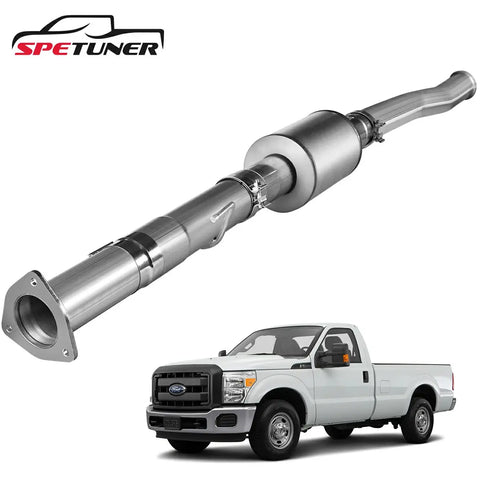
Get the exact sound and flow you need without buying a full bundle. This kit features mandrel-bent tubing for maximum flow and includes a high-flow muffler to eliminate the harsh "raspy" tone often found in straight-pipe setups.
The Complete Delete Solution
Exhaust diameter alone does not make a functional delete system. Proper tuning is required to manage increased exhaust flow and disabled emissions components. For 2011-2019 owners, the most reliable path is to install a complete 6.7 Powerstroke emissions removal kit.
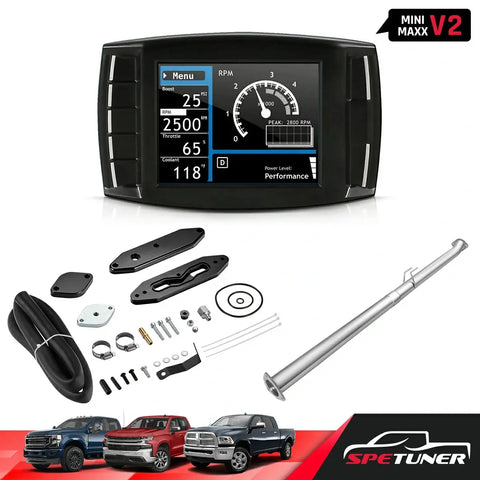
This bundle allows you to choose between a 4" or 5" stainless steel race pipe, ensuring you get the exact sound and performance profile you want. Combined with the Mini Maxx V2 Tuner and EGR Delete, it's the comprehensive solution for a reliable, powerful build.
Conclusion
If your 6.7 Powerstroke is a workhorse—towing, commuting, or traveling long distances—the 4-inch exhaust is the smartest, most comfortable, and most reliable choice.
If your truck is built for sound, show, or serious horsepower, and you understand the comfort trade-offs, the 5-inch exhaust delivers the aggressive character you want.
Once you have selected your exhaust, you may want to look into other performance upgrades. Feel free to browse our full Ford 6.7 Powerstroke Delete Kits to find intakes, delete pipe, tuner, and other supporting mods to match your new setup.
All emissions-related modifications are intended for off-road or competition use only. Always verify local regulations and legal risks before modifying your vehicle.
Frequently Asked Questions (FAQ)
Q1: Will a 5-inch exhaust give me more horsepower than a 4-inch?
A: On a truck with a stock turbo and fuel system, no. Both sizes flow significantly more than the engine requires. You won't see a measurable HP difference until you upgrade to a larger non-VGT turbo or exceed 650+ HP.
Q2: Does the 5-inch exhaust fit with a full-size spare tire?
A: Yes, but it is a very tight fit. You may need to loosen the spare tire winch, push the tire toward the driver's side, and re-tighten it to gain the necessary clearance. 4-inch systems clear the spare tire without adjustment.
Q3: Do I need a muffler?
A: If you are choosing a 5-inch system and plan to tow, we highly recommend adding a muffler. It helps kill the "drone" frequency without restricting power. For 4-inch systems, a muffler is optional as the natural sound is less booming.
Q4: Why does the 5-inch system drone?
A: Drone is caused by sound waves resonating at a specific frequency that matches the cabin's natural acoustic frequency. The larger diameter and lower tone of the 5-inch pipe often hit this frequency resonance right at highway cruising RPMs (1800-2000).
Q5: Can I install a tip on these exhausts?
A: Yes. Most owners add a tip for aesthetics. Note that a massive tip (like 6" to 8") can essentially act as a megaphone, amplifying the sound and potentially increasing drone.
Q6: Will I lose low-end torque with a 5-inch straight pipe?
A: Theoretically, yes, due to reduced exhaust velocity (scavenging effect) at low RPMs. However, because the 6.7L VGT (Variable Geometry Turbo) is so efficient at managing backpressure, most drivers will not feel a noticeable loss in torque from the driver's seat.
Q7: Which one lowers EGTs (Exhaust Gas Temperatures) more?
A: Both will drop EGTs by 200-300°F compared to stock. The 5-inch pipe has a slight advantage in heat dissipation during extreme towing or race scenarios, but for 95% of driving, the cooling benefit is identical.
Q8: Is the installation difficulty different?
A: The removal of the stock DPF is the same for both (and is the hardest part). Installing the new pipe is easier with the 4-inch kit because the over-axle section threads through the chassis gaps much smoother than the bulky 5-inch pipe.
Q9: Can I start with a 4-inch and switch to a 5-inch later?
A: You would need to buy a completely new pipe kit. However, your Tuner (EZ LYNK or Mini Maxx) will work fine with either size. You do not need to re-tune the truck just for changing pipe diameter. For more on tuning, see our guide to selecting the best tuner.
Q10: Which one sounds more like a jet engine?
A: The 4-inch system highlights the high-frequency turbo whistle (the "jet" sound) better. The 5-inch system's deep rumble tends to mask some of that whistle, resulting in a sound that is more "truck" and less "turbine."

Lars
Diesel Performance Engineer | 15+ Years EXPERIENCE
"Empower Your Beast: Run Cooler, Pull Harder, Last Longer."