For most 2011–2019 Ford 6.7L Powerstroke owners, repairing the OEM DEF/DPF system is no longer the most cost-effective option.
Dealership repairs typically run $4,000–$6,000 and often fail again, while a complete 6.7 Powerstroke delete kit usually costs $1,200–$2,000 and permanently removes the root cause of Limp Mode. Beyond reliability, most owners see a real-world fuel economy expectation of 2–4 MPG improvement.
If you are reading this, chances are you are staring at a “Speed Limited to 50 MPH” warning or holding a repair estimate that feels absurd for a truck that otherwise runs strong. You are not alone. On the 6.7L Powerstroke, the Bosch-supplied emissions system is statistically the most common and most expensive failure point.
Before authorizing a repair that may cost more than a month’s mortgage payment, it’s worth understanding the real math behind emissions failures—and why so many owners choose to fix the problem once instead of feeding it forever.
Recognizing the Signs: DEF / DPF Failure Symptoms
Emissions failures rarely happen without warning. The 6.7L Powerstroke usually provides clear symptoms well before the truck becomes undrivable. Ignoring these signs only increases repair costs. Knowing how to start troubleshooting common emission failures can save you from being stranded.
-
Limp Mode Countdown:
Messages such as “Speed Limited to 50 MPH in 50 Miles” indicate the final stage of failure. Once the countdown reaches zero, the ECU severely restricts power, making towing or highway driving impractical. -
Excessive Regeneration Cycles:
A healthy DPF regenerates roughly every 300–500 miles. If your truck initiates regen every 100 miles or less, the DPF is likely ash-loaded and nearing the end of its service life. -
Common Diagnostic Trouble Codes:
- P20EE – SCR NOx Catalyst Efficiency Below Threshold
- P207F – Reductant Quality Performance (“Bad DEF” code)
- P20BD – Reductant Heater Control Circuit Open
-
DEF Crystallization & Pump Noise:
White crust around the DEF injector or a loud buzzing from the DEF tank often indicates pump or injector failure caused by crystallized fluid.
The Reality of Repairs: Why OEM Fixes Become a Money Pit
Many owners assume replacing the failed component will solve the issue. Unfortunately, the 2011–2019 emissions system is an interconnected network. When one part fails, it often accelerates failure in others.
Replacing a heater today does nothing to prevent the DPF from clogging tomorrow or the NOx sensors from failing next winter. This is why a detailed cost analysis of diesel repairs often favors a full delete over piecemeal fixes.
In practical terms, repairing the system is like playing Whac-A-Mole—each fix exposes the next weak link.
Typical Dealership Repair Costs (Estimates)
The key takeaway: once a single DEF or DPF component fails, most owners end up replacing multiple parts within 12–18 months.
| Component | Function | Estimated Cost |
|---|---|---|
| NOx Sensors (Front & Rear) | Monitor emissions output; prone to soot contamination | $800–$1,200 |
| DEF Heater / Sender | Prevents DEF freezing; common cold-weather failure | $900–$1,400 |
| DEF Pump | Injects fluid into exhaust; susceptible to crystallization | $1,100–$1,500 |
| OEM DPF Filter | Traps soot; fills with ash over time | $3,000–$4,500 |
| SCR Catalyst | Reduces NOx emissions | $1,800–$2,500 |
| Total Potential Cost | If multiple components fail | $5,000–$8,000+ |
Expert Insight: Spending $4,000 today does not upgrade your truck. It simply resets the countdown to the next emissions failure.
6.7 Powerstroke Delete Kit Costs & Components (2011–2019)
A delete kit is not a repair—it is a one-time system replacement. Most complete kits cost between $1,200 and $2,000. You can browse Ford Powerstroke solutions to find the exact configuration for your truck's year.
Once installed, the components that cause Limp Mode and repeated emissions faults are removed entirely.
The Three Core Components
-
Tuner (Control Logic):
Devices such as EZ LYNK or Mini Maxx reprogram the ECU to ignore DPF and DEF sensors, permanently preventing Limp Mode and emissions-related fault codes. -
Delete Pipe (Exhaust Flow):
Replaces the DPF and catalytic converter, reducing backpressure and allowing the turbo to spool faster with lower exhaust gas temperatures. -
EGR Delete Kit (Clean Intake Air):
Stops soot-laden exhaust from entering the intake, keeping oil cleaner and reducing long-term engine wear. For more on this, read about the reliability benefits.
Instead of buying these parts individually, most owners prefer to solve the problem permanently with an all in one 6.7 powerstroke delete kit.
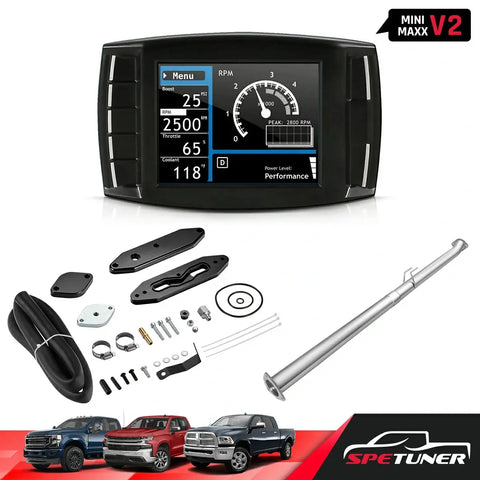
Stop chasing expensive repairs. This complete bundle replaces the failure-prone DPF, DEF, and EGR systems entirely. It includes the Mini Maxx V2 tuner for code-free operation and high-flow stainless steel piping to restore reliability and power. Fix it once and for all.
Model Year Note: Kits vary between 2011–2014, 2015–2016, and 2017–2019 trucks. Always select a year-specific bundle to ensure correct ECU and transmission tuning.
Delete vs. Repair: Side-by-Side Comparison
This comparison makes one thing clear: OEM repairs restore emissions compliance, while a delete kit restores reliability and long-term operating cost control.
| Factor | OEM Repair | Full Delete Kit |
|---|---|---|
| Reliability | Low; repeat failures likely | High; failure points removed |
| Engine Health | Soot ingestion and high backpressure | Lower EGTs, cleaner oil |
| Fuel Economy | Wasted fuel during regens | +2–4 MPG improvement |
| Throttle Response | Delayed | Immediate |
| Cost | $4,000–$6,000+ recurring | $1,200–$2,000 one-time |
ROI Analysis: Fuel and DEF Savings
This is where a 6.7 Powerstroke delete kit often pays for itself faster than expected. Our data on fuel efficiency expectations shows significant savings over time.
- Miles per year: 20,000
- Stock fuel economy: 14 MPG
- Deleted fuel economy: 17 MPG
- Diesel price: $4.00 / gallon
Estimated annual fuel savings: ~$1,000
Additional DEF savings: $300–$500 per year
Total annual savings: approximately $1,400. For many owners, the kit pays for itself in just over one year.
Installation & Legal Considerations
- Installation Time: 4–6 hours; moderate mechanical skill required.
- Switch-on-the-Fly Tuning: Allows power level changes without shutting the truck off.
- Legal Disclaimer: For off-road and competition use only. Not legal for use on public highways. Always start by understanding emissions regulations in your area.
Conclusion: Stop Renting Your Reliability
Continuing to repair the factory emissions system on a Ford 6.7L Powerstroke is a recurring expense with no long-term upside. For high-mileage trucks, a properly tuned Ford 6.7L Powerstroke delete kit is not a modification—it is a reliability strategy.
Frequently Asked Questions (FAQ)
Q1: How much does a full delete cost for a 6.7 Powerstroke?
A1: A complete delete bundle (including Tuner, Pipe, and EGR Kit) typically costs between $1,200 and $1,800 for parts. If you hire a shop for installation, expect to pay an additional $500–$800 in labor. Compared to a dealership DPF replacement ($4,000+), deleting saves you thousands upfront and eliminates future repair costs.
Q2: Will deleting my 6.7 Powerstroke fix "Limp Mode"?
A2: Yes, absolutely. "Limp Mode" (or "Speed Limited to 50mph") is triggered by sensors in the DPF/DEF system detecting a fault. Since the delete kit and tuner completely remove these sensors from the truck's software logic, the error codes clear immediately, and full power is restored permanently. Check our guide on troubleshooting common limp mode triggers for more details.
Q3: How much MPG gain can I expect after deleting?
A3: Most 6.7L Powerstroke owners report an immediate increase of 2–4 MPG (both city and highway). This is because the engine no longer wastes fuel on "Regen" cycles to burn soot, and the turbo can exhale freely without restrictive filters.
Q4: Will deleting my truck void the warranty?
A4: Yes. Deleting the emissions system will void the manufacturer's powertrain warranty. However, since the 2011–2019 models discussed in this guide are mostly out of their factory warranty period anyway, this is rarely a concern for owners of these specific model years.
Q5: Do I still need to fill the DEF tank after a delete?
A5: No. Once the tuner is installed, the DEF (Diesel Exhaust Fluid) system is electronically disabled. You never need to buy BlueDEF again. You can leave the tank empty, or physically remove the tank to save weight.
Q6: Does deleting the DPF increase horsepower?
A6: Yes. Even on a "stock" power tune, removing the restrictions adds some response. However, most tuners (like EZ LYNK or Mini Maxx) come with power levels ranging from +50HP to +200HP. You can safely run a +50HP "Tow Tune" for daily driving without stressing the engine.
Q7: Can I pass emissions testing with a deleted truck?
A7: No. A deleted truck will not pass a visual inspection or an OBDII emissions plug-in test, as the emissions monitors are turned off. These kits are sold strictly for competition and off-road use. Always review the legal risks of diesel modification before proceeding.
Q8: How long does a deleted 6.7 Powerstroke engine last?
A8: A deleted 6.7L engine typically lasts much longer than a stock one. By removing the EGR (which feeds soot into the intake) and the DPF (which creates heat and backpressure), you reduce engine wear, keep the oil cleaner, and lower exhaust gas temperatures (EGTs). Many deleted 6.7Ls surpass 500,000 miles easily.
Q9: How hard is it to install a delete kit myself (DIY)?
A9: It is considered a moderate difficulty job, taking roughly 4–6 hours. The hardest part is usually removing the factory downpipe due to tight clearances. For a better idea of the process, check our step-by-step installation instructions.
Q10: Does the delete kit remove the muffler too?
A10: It depends on the pipe you choose. A "Downpipe-Back" exhaust usually removes the DPF and CAT but can keep the stock muffler if you want it quiet. A "Straight Pipe" removes everything, including the muffler, resulting in a very loud, aggressive jet-engine sound. Most owners prefer a straight pipe with a resonator to balance sound and flow.

Lars
Diesel Performance Engineer | 15+ Years EXPERIENCE
"Empower Your Beast: Run Cooler, Pull Harder, Last Longer."