Picture this: You're three miles into a 6% grade in the Rockies, towing your 15,000-lb fifth wheel. Your eyes dart between the road and your gauges—exhaust gas temperatures climbing past 1,300°F, oil temp creeping toward the red zone, and that sinking feeling in your gut, wondering if this is the pull that's going to cost you a head gasket.
If you've been there, you know the anxiety isn't about the load—it's about what your truck's emission system is doing to your engine under stress.
Here's the truth most dealers won't tell you: The factory DPF and EGR system isn't protecting your engine when you're working it hard. It's choking it. Understanding the efficiency gains from deleting is the first step toward a cooler-running engine.
At SPEtuner, we believe in data, not fear-mongering. Below is the technical breakdown of why a properly deleted truck is the only way to guarantee longevity for heavy towing.
How does deleting drop EGTs by 200-300°F?
Think of your DPF (Diesel Particulate Filter) as a potato in your tailpipe. To force exhaust through that ceramic brick, your turbocharger works against massive Drive Pressure. For 2011-2019 models, installing a 2011-2019 6.7 Powerstroke Delete Kit is the most effective way to eliminate this restriction.
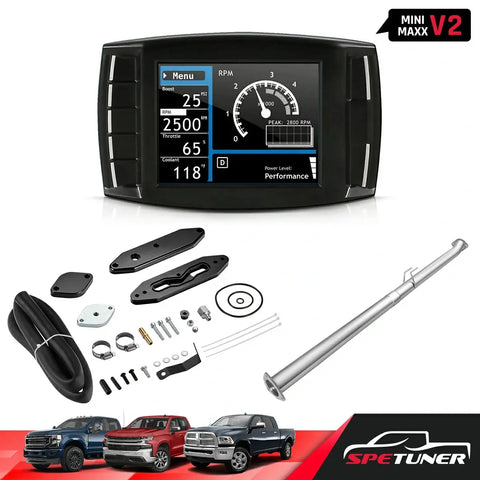
This is the ultimate towing upgrade. By replacing the restrictive factory exhaust and EGR system, this kit lowers EGTs by up to 300°F. Includes a pre-loaded tow tune on the Mini Maxx V2 to optimize transmission shift points and cooling.
6.7 Powerstroke Towing Data Comparison: Deleted vs. Stock
We compared a stock 2018 F-350 against the same truck equipped with a SPEtuner All-in-One Kit (Tow Tune) carrying a 14,000 lb load.
| Metric | Stock Truck (Regen Mode) | Deleted Truck (Tow Tune) | The Benefit |
|---|---|---|---|
| Peak EGTs | 1,420°F | 1,150°F | Prevents head warping. |
| Coolant Temp | 235°F | 205°F | Protects cooling system. |
| Oil Dilution | 5-8% (High Risk) | <0.5% (Safe) | Protects rod bearings. |
The Verdict: Deleting drops EGTs by an average of 250°F - 300°F under sustained load. That is the difference between a reliable workhorse and a shop queen.
The factory chokepoint creates excessive backpressure
Think of your 6.7L Ford DPF (Diesel Particulate Filter) like asking a marathon runner to breathe through a straw. To force exhaust gases through the restrictive honeycomb filter, your turbocharger has to work against extreme backpressure—sometimes 40+ PSI at full towing load.
What happens under the hood:
- Higher backpressure traps heat in the exhaust manifold
- Your turbo spins harder just to maintain boost, generating more heat
- Exhaust gas recirculation (EGR) forces hot exhaust back into the intake, raising combustion temperatures
- All that trapped thermal energy has nowhere to go but into your engine block, heads, and coolant system
The delete advantage provides unrestricted exhaust flow
Once you remove the DPF restriction, the physics change immediately:
Thermal benefits you'll measure:
- EGT reduction of 200-300°F under sustained load (documented in controlled towing tests)
- Faster heat dissipation as exhaust flows freely through straight pipe or performance exhaust
- Lower cylinder head temperatures, reducing thermal stress on head gaskets and valve train components
- Reduced coolant system burden, keeping your engine in the optimal 190-210°F range even on long climbs
Real-world example: One of our customers who regularly hauls a 14,500-lb livestock trailer through Wyoming reported his peak EGTs dropped from 1,380°F (stock) to 1,090°F (deleted with tow tune)—that's a 290°F difference that translates directly to reduced thermal fatigue on critical engine components.
Lower EGTs are essential for engine longevity
Head gasket failure is the #1 catastrophic failure on 6.7 Powerstrokes under heavy load. The multi-layer steel (MLS) gaskets are designed to handle significant pressure, but thermal cycling is their enemy. Every time you heat-soak your heads to 1,300°F+ and then cool down, you're microwarping the sealing surface.
Keeping peak EGTs under 1,150°F during towing isn't just about peace of mind—it's about preserving your $8,000 cylinder heads and $3,500 head gasket job.

Can reliability be improved by removing Regen and Oil Dilution?
Active regeneration poses a hidden danger to your engine
Most truck owners don't realize what happens during a DPF regeneration cycle—and why it's particularly destructive during towing season when your engine is running hot and working hard. Recognizing the early symptoms of DPF failure can help avoid catastrophic damage.
The regeneration process:
- Your ECU detects DPF soot load reaching threshold
- On the exhaust stroke, the injectors spray raw diesel fuel into the cylinder
- This fuel doesn't combust—it's designed to pass into the exhaust system to burn off soot in the DPF
- But here's the problem: some of that fuel washes down the cylinder walls and contaminates your crankcase oil
Oil dilution acts as a silent killer for towing engines
When diesel fuel mixes with your engine oil, several destructive processes begin:
Immediate effects:
- Fuel reduces oil viscosity (your 15W-40 can thin to the consistency of 5W-20)
- Compromised oil film strength on critical bearing surfaces
- Reduced lubrication protection exactly when your engine needs it most—under heavy load
Long-term damage:
- Main bearing wear accelerates as the oil film breaks down under pressure
- Rod bearing failure risk increases (a common failure point on high-mileage towing trucks)
- Turbocharger bearing damage from oil starvation
- Cam and lifter wear from insufficient lubrication film
The data: Oil analysis from heavy-towing stock trucks commonly shows 3-8% fuel dilution after just 3,000 miles. That same analysis on deleted trucks? Consistently under 0.5%.
The delete solution ensures pure oil and protection
By eliminating the DPF system entirely:
- ✅ No forced regeneration cycles
- ✅ No post-injection fuel washing into the crankcase
- ✅ Oil maintains full viscosity and additive package integrity
- ✅ Extended oil change intervals become safer (we still recommend 5,000 miles for heavy towing)
- ✅ Critical bearing surfaces get the protection they need under sustained load
Bottom line: When you're towing 15,000 lbs up a mountain pass, the last thing you need is contaminated oil failing to protect your bearings. A delete kit gives you pure lubrication exactly when it matters most.
Real Towing MPG after a delete
Setting Realistic Expectations
Let's be honest: You're not going to get 30 MPG towing a triple-axle toy hauler. Anyone promising that is selling snake oil. But the improvements are measurable, consistent, and significant—especially over thousands of miles of annual towing.
The Physics of Improved Efficiency
When you remove exhaust restrictions and optimize fuel delivery with proper tuning:
Engine efficiency gains:
- Reduced parasitic drag from pumping exhaust against backpressure
- Improved volumetric efficiency (your engine breathes in more air, uses fuel more completely)
- Optimized injection timing without EGR dilution lowering combustion temperatures
- Turbo efficiency improves (less work to achieve target boost = less fuel consumption)
Real-world MPG data confirms the gains
Based on data from hundreds of customer reports and controlled testing, the gains are substantial:

Unloaded driving (empty bed/no trailer):
- Stock average: 14-16 MPG highway
- Deleted with economy tune: 17-21 MPG highway
- Improvement: 3-5 MPG (20-30% gain)
Towing heavy loads (10,000-16,000 lbs):
- Stock average: 8-10 MPG
- Deleted with tow tune: 9.5-12.5 MPG
- Improvement: 1.5-3 MPG (15-25% gain)
Improved MPG and ROI matter for long-term ownership
Let's run the math on a typical RV owner towing 6,000 miles per year. For a more detailed breakdown, see our cost savings analysis.
Stock truck at 9 MPG:
- 667 gallons consumed
- At $4.00/gallon = $2,668 annual fuel cost
Deleted truck at 11 MPG:
- 545 gallons consumed
- At $4.00/gallon = $2,180 annual fuel cost
Annual savings: $488
Over a 5-year ownership period, that's $2,440 in fuel savings—enough to cover a significant portion of your delete kit investment, while also giving you 30% more range between fuel stops (critical when towing through remote areas).
The Range Anxiety Factor
Beyond cost savings, there's a practical safety benefit: fewer fuel stops when towing means fewer risky maneuvers into crowded truck stops, less time exposed to highway traffic, and more confidence planning routes through areas with limited diesel availability.
The Transmission: 6R140 vs. 10R140 Tuning
This is where generic "box tuners" fail. You cannot tune the engine without tuning the transmission (TCM), especially for towing.
- For 6R140 Owners (2011-2019): The 6-speed is robust but prone to "flare." SPEtuner's TCM files increase line pressure to clamp clutches instantly.
- For 10R140 Owners (2020+): The 10-speed runs hotter and loves to "gear hunt." Our Tow Files hold gears longer, keeping fluid cool and RPMs efficient.
How do you choose the right Tow Tune for your 6.7 Ford?
The #1 Mistake That Destroys Engines
Here's where many truck owners go wrong—and it's the reason deleted trucks sometimes get a bad reputation:
❌ Wrong: Installing a +200HP "Hot Street" tune and using it to tow heavy loads
✅ Right: Installing a dedicated tow tune (typically +0 to +60HP) designed for sustained load
The difference between these tuning approaches is like the difference between sprinting a 100-meter dash versus running a marathon. Your engine needs completely different fuel and timing strategies. Check out our guide on selecting the right tow tune for more advice.
What a Proper Tow Tune Actually Does
A quality tow-specific tune isn't just about limiting power—it's about optimizing every aspect of engine and transmission behavior for sustained heavy work:
Fuel delivery optimization:
- Conservative injection timing to minimize peak cylinder pressure
- Extended injection duration for complete combustion without excess heat
- Reduced pilot injection to lower EGTs while maintaining torque
- Optimized injection pressure for fuel atomization and efficiency
Transmission logic reprogramming:
- Earlier torque converter lockup (reduces slippage heat and improves efficiency)
- Firmer shift points to minimize clutch pack slippage under load
- Modified shift schedule to keep engine in optimal RPM range (typically 1,800-2,400 RPM for the 6.7)
- Increased line pressure under load to protect clutches and prevent slip
Turbo boost management:
- Limited peak boost to reduce thermal and mechanical stress
- Optimized boost curve for linear torque delivery without spiking EGTs
- Wastegate control tuned for steady boost under varying load conditions
Power Level Selection Guide
For regular heavy towing (12,000+ lbs):
- Economy/Tow Tune: +0 to +30HP
- Focus: MPG, low EGTs, transmission protection
- Best for: Daily towing, cross-country RV trips, commercial use
For mixed use (occasional towing, daily driving):
- Tow/Performance Tune: +40 to +60HP
- Focus: Balanced power and efficiency
- Best for: Weekend warriors, seasonal RV use, light commercial
For empty-truck driving only (NOT for towing):
- Performance Tune: +80 to +150HP
- Focus: Responsiveness, passing power, fun factor
- ⚠️ Never use these tunes when towing heavy loads
Switching Between Tunes: When and Why
Modern tuners allow on-the-fly tune switching. Here's the smart strategy:
- Before hooking up: Switch to tow tune
- During the trip: Stay in tow tune (no exceptions, even on flat highway miles)
- After unhitching: Switch to performance or economy as desired
- If climbing severe grades: Some tuners allow you to drop to an even more conservative tune—don't be afraid to use it
Pro tip: If your EGTs are consistently above 1,200°F while towing, drop down one power level. The goal is to complete the trip safely, not to prove how much power your truck makes.
Why is digital monitoring mandatory for haulers?
Why Factory Gauges Aren't Enough
Your stock instrument cluster shows you oil pressure, coolant temperature, and maybe a basic "check engine" light. That's not nearly enough information when you're towing at the edge of your truck's capacity.
Critical parameters you need to monitor in real-time:
Exhaust Gas Temperature (EGT):
- Your primary indicator of thermal stress
- Safe towing range: 900-1,150°F sustained
- Caution zone: 1,150-1,250°F
- Danger zone: 1,250°F+ (back off throttle, downshift, or pull over)
Boost Pressure:
- Indicates turbo load and engine breathing efficiency
- Normal towing: 20-35 PSI
- Helps diagnose leaks, restrictions, or tuning issues
Transmission Temperature:
- Critical for transmission longevity under load
- Safe range: 180-200°F
- Acceptable under heavy load: 200-220°F
- Warning zone: 220°F+ (reduce speed, downshift, or cool down)
Fuel Pressure:
- Ensures injectors are getting adequate fuel supply
- Diagnoses failing lift pumps or clogged filters before they cause damage
Our Solution: Integrated Monitoring With Delete Kits
Most quality delete kits include a tuner device with a built-in display screen (such as Mini Maxx, EZ Lynk AutoAgent, or SCT X4). These aren't just tuning devices—they're your digital co-pilot.
Real-time benefits while towing:
- Large, readable gauges showing all critical parameters
- Customizable alarm thresholds (get warned before problems develop)
- Data logging for troubleshooting or performance optimization
- Multiple screen layouts (switch from gauges to diagnostics instantly)
Peace of mind value:
Instead of guessing whether your truck is safe on that 7-mile grade, you know exactly what's happening under the hood. When EGTs stay under 1,100°F and transmission temp holds at 195°F, you can relax and focus on driving—not worrying about catastrophic failure.
Advanced Monitoring: OBD Port Adapters
For serious haulers who want even more data, Bluetooth OBD adapters paired with smartphone apps provide:
- Individual cylinder EGT monitoring (catch uneven temperatures indicating injector issues)
- Detailed transmission data (clutch slip percentages, individual gear ratios)
- Long-term trend analysis (compare EGTs on the same route over time)
- GPS-tagged data logging (know exactly which grades push your limits)
Investment perspective: A quality monitoring setup ($300-800 depending on features) can save you a single catastrophic repair. One prevented transmission failure or head gasket job pays for the monitoring equipment ten times over.
Is a delete right for your specific operation?
The 6.7 Powerstroke is an exceptionally strong platform—Ford's engineers designed it to handle serious work. But the emission controls required by EPA regulations were never optimized for the kind of sustained, heavy-load towing that truck owners actually need to do.
A delete kit doesn't make your truck a race vehicle. It returns your truck to its fundamental purpose: moving heavy loads reliably, efficiently, and safely.
The Delete Advantage Summary:
✅ 200-300°F lower EGTs under sustained towing load
✅ Zero oil dilution from regeneration cycles
✅ 1.5-3 MPG improvement when towing heavy
✅ Extended engine longevity through reduced thermal stress
✅ Real-time monitoring of all critical parameters
✅ Transmission protection through optimized shift logic
✅ Peace of mind on every grade, every mile
If you regularly tow heavy loads (10,000+ lbs), cover serious miles (5,000+ towing miles annually), or push your truck to its capacity in commercial, agricultural, or recreational use—a delete kit is an investment in reliability, not a performance modification.
Ready to Upgrade Your Towing Confidence?
Our 6.7 Powerstroke delete kits are specifically configured for heavy towing reliability:
What's included:
- Complete DPF/EGR/CCV/DEF removal components
- Tuner device with real-time monitoring screens
- Multiple tune files including dedicated tow programs
- Lifetime tuning updates and support
- Installation support from technicians who understand heavy hauling
👉 Browse 2011-2019 6.7 Powerstroke Delete Kits ← Configured for haulers who demand reliability
👉 Browse SPEtuner all 6.7 Powerstroke performance parts ← Performance upgrades for the serious tow rig.
📞 Chat with our support team: Speak with a diesel specialist about your specific towing needs, typical routes, and performance goals. We'll recommend the exact components and tuning strategy to maximize reliability and efficiency for your operation.
Frequently Asked Questions (FAQ)
Q1: How does deleting affect EGTs when towing?
A1: Deleting restrictive DPF and EGR systems typically lowers Exhaust Gas Temperatures (EGTs) by 200-300°F under sustained load. This reduction is critical for preventing cylinder head warping and head gasket failures on the 6.7 Powerstroke.
Q2: What is the best tune for towing heavy loads?
A2: Always use a dedicated Tow Tune (+0 to +60HP). You should strictly avoid high-horsepower "Street" or "Race" tunes while towing, as they inject excessive fuel that can cause dangerous EGT spikes and melt pistons under load.
Q3: Will a delete kit improve towing MPG?
A3: Yes, most owners report a 1.5-3 MPG improvement while towing. This efficiency gain comes from reduced exhaust backpressure (parasitic loss) and the complete elimination of fuel-wasting regeneration cycles. See our report on real-world fuel economy expectations for more details.
Q4: Is it safe to tow immediately after deleting?
A4: Yes, provided you have installed a proper Tow Tune that optimizes transmission shift points for the new power curve. The transmission needs to learn the new torque output, so drive moderately for the first 50-100 miles before hauling max load.
Q5: How does deleting prevent oil dilution?
A5: Deleting stops the "active regeneration" process where raw diesel fuel is sprayed into the exhaust cylinders on the exhaust stroke. This prevents unburnt fuel from washing past the piston rings and diluting your engine oil, protecting your rod bearings.
Q6: Do I need to upgrade my transmission for towing?
A6: For standard heavy towing with a Tow Tune, the stock 6R140 or 10R140 transmission is robust enough. However, TCM (Transmission Control Module) tuning is highly recommended to increase line pressure and hold gears longer to reduce heat.
Q7: What EGT temperature is safe for towing?
A7: You should aim to keep sustained EGTs under 1,150°F. Short spikes to 1,250°F on steep grades are acceptable but should be brief. If temps exceed this, downshift or lift off the throttle immediately.
Q8: Can I tow with a street tune if I watch the gauges?
A8: No. Street tunes advance timing and fueling aggressively. Even if EGTs look okay momentarily, cylinder pressures can spike to dangerous levels, risking head gasket failure. Always switch to a Tow Tune before hooking up a trailer.
Q9: Does deleting void my warranty?
A9: Yes, deleting emissions equipment will void your factory powertrain warranty. This modification is best suited for trucks that are out of warranty or used exclusively for off-road/competition purposes.
Q10: What monitoring gauges are essential for towing?
A10: The four most critical parameters to monitor are EGT (Exhaust Gas Temperature), Transmission Fluid Temperature, Boost Pressure, and Coolant Temperature. The factory dash gauges are often "dummy lights" and do not react fast enough for tuned trucks.
Legal Notice: Emission system modification may not be legal in all jurisdictions. This content is provided for informational purposes for off-road, racing, or agricultural use only. Always consider legal compliance risks before making modifications to emission control systems. We do not advocate for illegal modification of on-road vehicles.

Lars
Diesel Performance Engineer | 15+ Years EXPERIENCE
"Empower Your Beast: Run Cooler, Pull Harder, Last Longer."