Quick Answer: How Much Does It Cost to Delete a Diesel Truck?
Based on SPEtuner's original cost model, a complete diesel delete package plus tuning commonly falls around $2,500–$6,000, while some late-model or electronics-heavy builds can reach roughly $4,000–$7,500.
The final number depends on engine generation, exact hardware, tuning platform, ECM requirements, labor, exhaust configuration, and vehicle condition.
If you are pricing a diesel delete, you may hear one owner say the job costs $2,500 while another says $6,000 or more. Both numbers can make sense because “deleting a diesel truck” can describe very different combinations of hardware, tuning, electronics, and labor.
Cost note: Dollar figures in this article combine SPEtuner internal test/service data, original planning ranges, and current SPEtuner website pricing. They are budgeting references rather than guaranteed quotes. Actual prices may vary by vehicle, configuration, selected options, shop labor rate, location, promotions, inventory, tax, shipping, and installation condition.
Compliance note: Federal Clean Air Act rules restrict tampering with required emissions controls and certain defeat devices. Cost information below is intended to explain the market and ownership economics around modified diesel trucks; it does not establish that a modification is legal for a specific street-driven vehicle.

Why Diesel Delete Cost Varies So Much
The advertised price of a diesel delete kit is rarely the complete project cost.
The biggest variables are:
- Truck model year
- Powerstroke, Cummins, or Duramax generation
- Pickup vs. Cab & Chassis
- DPF, EGR, DEF/SCR, CCV, or combined hardware scope
- Exhaust material and diameter
- Tuning device
- Calibration requirements
- ECM or PCM services
- Transmission calibration
- DIY vs. professional installation
- Rust, damaged fasteners, and existing engine problems
The Hidden Cost of Factory Emissions-System Repairs
EGR System Costs
In SPEtuner's original service/test dataset, an OEM EGR cooler replacement was budgeted at approximately $800–$1,500. The original dataset also recorded repeat EGR-related repair cases in roughly the 50,000–80,000-mile range on selected vehicles.

Test-data note: The 50,000–80,000-mile figure is retained from SPEtuner's original test/service data and should not be interpreted as a universal EGR cooler replacement interval. EGR life varies substantially with platform, duty cycle, coolant condition, calibration, load, idle time, operating temperature, and maintenance.
DPF Replacement Costs
The original SPEtuner cost analysis placed an OEM DPF replacement at roughly $3,000–$5,000 before additional sensors or related repairs.
Actual dealer and repair-shop pricing can vary considerably, so owners comparing repair versus modification costs should obtain a vehicle-specific repair quote first.
SPEtuner Factory Test Data: Performance After Selected Delete + Tune Configurations
SPEtuner's original factory, dyno, and real-world test records included the following performance and fuel-economy results on selected configurations:
| Measured / Reported Metric | SPEtuner Test Range |
|---|---|
| Horsepower Increase | 50–100+ HP on selected stock-turbo delete + tune configurations |
| Torque Increase | 100–200 lb-ft on selected tested configurations |
| Fuel-Economy Change | 2–5 MPG in selected test conditions |
| Efficiency Change | Approximately 15%–20% in selected test conditions |
| Additional Internal Test Record | Selected dyno and towing-log configurations recorded 20%+ horsepower gains and 15%+ fuel savings. |
SPEtuner test note: Performance and fuel-economy figures above are retained from SPEtuner factory/dyno and controlled real-world test configurations. They are not guaranteed results for every truck. Actual output varies with model year, engine condition, calibration version, turbocharger and fuel-system health, tire size, gearing, load, elevation, ambient temperature, fuel quality, regeneration history, and driving style.
SPEtuner factory-test note: These figures are reported from selected SPEtuner factory, dyno and real-world test configurations. They describe the tested combinations, not guaranteed results for every truck. Results vary with model year, engine condition, hardware, calibration, turbocharger and fuel-system health, transmission, tire size, gearing, towing load, idle time, regeneration history, elevation, ambient temperature, fuel quality and driving style. Percentage improvements and absolute HP, torque or MPG changes may describe different test cases and should not be added together.
Diesel Delete Cost by Engine Platform
The original SPEtuner platform cost model is retained below. These figures are best used as planning ranges rather than current SKU prices.
| Engine Platform | Original SPEtuner Planning Breakdown | Parts Cost (Est.) | Total w/ Install | Build Notes |
|---|---|---|---|---|
| Ford 6.7L Powerstroke 2011–2024 planning group |
EGR-related hardware: $300–$600 4" or 5" DPF pipe: $500–$800 OTF tuner: $800–$1,200 CCV reroute: $200–$400 |
$1,800–$3,000 | $2,500–$4,500 | Original SPEtuner performance planning data included 500+ HP potential on selected tuned configurations. Exact components differ between 2011–2019 and later trucks. |
| RAM 6.7L Cummins 2013–2024 planning group |
EGR/cooler hardware: $1,000–$1,500 DEF/SCR-related hardware: $300–$500 EFI Live / EZ Lynk tuning: $900–$1,400 5" turbo-back exhaust: $600–$1,000 |
$2,800–$4,400 | $3,500–$5,500 | Heavy-towing torque and VGT operation depend heavily on the exact tune, turbo condition, transmission strategy, and truck configuration. |
| GM 6.6L Duramax LML 2011–2016 / L5P 2017+ |
EGR-related hardware: $400–$700 DPF/SCR pipe: $600–$900 ECM service / unlock planning allowance: $1,000–$2,000 Cold-air intake: $300–$500 |
$3,500–$6,000 | $4,000–$7,500 | Later L5P electronics and tuning requirements can make the total build more expensive than older platforms. |
Pricing note: The platform figures above preserve SPEtuner's original internal cost model. They are not live product quotations. Current SKU pricing, tuner options, hardware combinations, labor, promotions, and compatibility may differ.
Cost-model note: The platform ranges above describe SPEtuner project-planning scenarios, not a shopping cart of current individual products. In particular, the listed GM component allowances total $2,300–$4,100, while the retained GM overall parts allowance is $3,500–$6,000. The original breakdown does not itemize that difference. Ask for a complete vehicle-specific quote; do not treat either range as a guaranteed component-by-component total.
What Does a Current SPEtuner Package Cost?
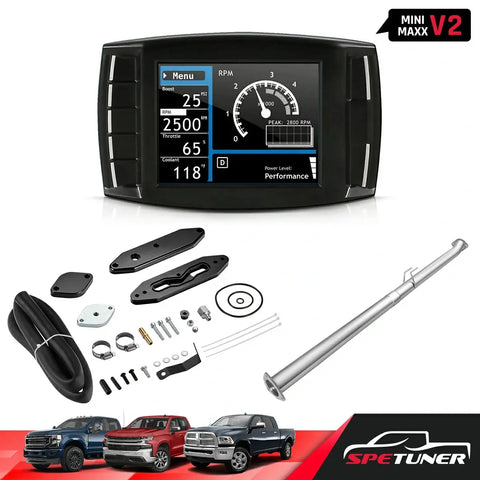
As one current real-world reference point, the SPEtuner 2011–2019 6.7L Powerstroke All-in-One Kit is displayed from $1,288.00 on the SPEtuner website at the time of this September 2026 review.
That current SKU price should not be confused with the total installed project cost. Variant choices, exhaust configuration, tuning options, labor, fluids, shipping, taxes, and unexpected repairs can all change the final number.
Price note: Product price based on the SPEtuner website during this September 2026 update. Prices and available configurations can change at any time. Verify the current product page before publishing a fixed price or placing an order.
Price note: Current product pricing is based on the SPEtuner website checked on September 16, 2026. The referenced 2011–2019 Powerstroke listing starts at $1,288.00, with listed variants up to $1,905.77. The selected variant, included hardware, tuning options, exhaust configuration, availability, promotions, shipping and taxes can change the amount payable. Product prices are separate from SPEtuner planning estimates for a complete project and are not installed-price quotations. Verify the selected product and checkout total before ordering.
Professional Installation and Labor Cost
| Service Tier | Cost Range | Original Time Estimate | What Changes the Bill |
|---|---|---|---|
| Shop Labor | $125–$175/hour | 4–8 hours for the original full-project planning model | Platform, rust, seized fasteners, cooling-system work, accessibility, diagnostics, electronics, and unexpected repairs. |
Labor note: The $125–$175/hour and 4–8-hour figures are retained from the original SPEtuner planning data. Actual labor rates and billed hours vary substantially by location, vehicle configuration, shop policy, and condition.
Hidden Costs Owners Often Forget
Broken or Rusted Hardware
Older exhaust clamps and fasteners may not survive removal. Road salt can change a straightforward project into several additional hours of work.
Fluids and Gaskets
Projects involving coolant routing can require replacement coolant, seals, clamps, fittings, and hardware.
Diagnostic Work
If the truck already has a check-engine light, hard starting, smoke, boost issues, or reduced power, those problems may need to be diagnosed separately.
Battery Support and Programming
Stable battery voltage matters during programming. A weak battery or interrupted flash can create costs that were not in the original parts budget.
Transmission Calibration
Some owners budget only for engine tuning and later discover the transmission strategy also needs attention.
Returning the Truck to Stock
If the truck later needs to be sold, traded, registered elsewhere, or restored to its certified configuration, another round of hardware and labor may be required.
All-in-One Kit vs. Buying Parts Separately
Buying parts separately can look cheaper when each component is viewed on its own.
The downside is the possibility of later discovering that you still need another exhaust section, fitting, tuning platform, calibration, clamp, or hardware package.
SPEtuner Original ROI Model
The original SPEtuner cost article used the following ownership-cost model:
| ROI Metric | Original SPEtuner Model |
|---|---|
| Initial Investment | $2,500–$6,000 average planning range for a complete package + tune |
| Annual Fuel-Savings Model | $800–$1,500 under the original SPEtuner test/usage assumptions |
| Potential Avoided DPF Repair | $3,000+ used in the original model |
ROI note: This is the original SPEtuner internal ownership model, not a guaranteed payback calculation. Fuel savings depend on annual mileage, fuel price, previous regeneration frequency, towing, tune, driving conditions, and vehicle health. Repair avoidance only applies when the modeled component would otherwise have required the assumed repair.

How to Compare Two Diesel Delete Quotes
Do not compare only the final number. Ask what each quote actually includes:
- Exhaust hardware?
- EGR-related hardware?
- CCV components?
- Tuning device?
- Calibration?
- Transmission tuning?
- ECM services?
- Labor?
- Fluids and gaskets?
- Technical support?
A $1,500 hardware package and a $4,000 installed quote may not actually be competing quotes.
Should You Repair the Factory System Instead?
Before spending several thousand dollars, compare the cost with repairing the actual fault.
If the problem is a single pressure sensor, thermostat, boost leak, NOx sensor, or serviceable DPF, repairing the original system can cost considerably less than a major build.
The right comparison starts with diagnosing the original fault rather than assuming every emissions warning requires the same solution.
Explore Diesel Delete Kits for Powerstroke, Cummins & Duramax
Compare current SPEtuner package prices for Powerstroke, Cummins and Duramax trucks. Check the selected variant and included hardware, then budget separately for labor, fluids, diagnostics, shipping and taxes.
Shop Diesel Delete Kits →References
- U.S. Environmental Protection Agency: "Air Enforcement — Defeat Devices and Tampering." Available from U.S. EPA.
- Electronic Code of Federal Regulations: "40 CFR §1068.101 — General Prohibited Actions." Available from Legal Information Institute.
- SPEtuner: Current product and collection pricing used for live-price references in this update. Available from SPEtuner Diesel Delete Kit Collection.
FAQ
Q1: How much does it cost to fully delete a diesel truck?
A1: SPEtuner's original planning model places many complete projects around $2,500–$6,000, while more complex late-model configurations can reach roughly $4,000–$7,500.
Q2: Why are some diesel delete products only a few hundred dollars?
A2: The advertised price may cover only one hardware component and may not include tuning, calibration, other emissions-related hardware, ECM services, labor, fluids, or installation.
Q3: How much does diesel delete tuning cost?
A3: The original SPEtuner platform model included approximately $800–$1,400 for several common tuning configurations, but current tuner and calibration pricing depends on the exact platform and service.
Q4: Can a diesel delete improve fuel economy?
A4: In selected SPEtuner factory and real-world test configurations, recorded changes included 2–5 MPG and roughly 15%–20% efficiency improvement. Those results are not guaranteed and can change substantially with the truck, tune, duty cycle, weather, load, tires, gearing, and driving style.
Q5: How much horsepower can a deleted and tuned diesel gain?
A5: Selected SPEtuner stock-turbo test configurations recorded approximately 50–100+ HP and 100–200 lb-ft increases. The result depends on engine platform, tune, fuel system, turbocharger, transmission, and vehicle condition.
Q6: Is it cheaper to buy an all-in-one kit?
A6: It can simplify compatibility and reduce missing-component problems when you need a complete package, but the best-value option depends on what parts you already own and what is included.
Q7: Does deleting a diesel guarantee lower maintenance cost?
A7: No. It can change certain emissions-related repair categories, but the turbocharger, fuel system, transmission, cooling system, engine, electrical systems, and other components still require maintenance and can fail.

Lars
Diesel Performance Engineer | 15+ Years Experience
"Empower Your Beast: Run Cooler, Pull Harder, Last Longer."