Quick Answer
A 6.0 Powerstroke EGR delete is worth it if your goal is to remove EGR cooler failures, reduce intake carbon, lower EGT, and improve long-term reliability.
Make the decision in four steps:
- Confirm that your truck has EGR cooler or EGR valve problems.
- Check the oil cooler, cooling system, turbo, and head gaskets.
- Decide whether the truck is used on public roads or only off-road.
- Use the correct delete kit and professional ECU calibration.
Key reminder: An EGR delete removes EGR-related problems, but it will not repair unrelated 6.0 Powerstroke faults.
Notice: Yes, a 6.0 Powerstroke EGR delete is worth it for many owners. It removes one of the engine’s best-known failure points, reduces carbon buildup, lowers engine and exhaust temperatures, and can improve performance and fuel economy.
The main issue is not whether an EGR delete works. It does. The real question is whether it fits how you use your truck. A daily driver, tow rig, work truck, and off-road build do not have the same needs.
Which Trucks Use the 6.0 Powerstroke EGR System?
This guide applies to Ford vehicles equipped with the 6.0L Power Stroke diesel engine, including:
- 2003–2007 Ford F-250 Super Duty
- 2003–2007 Ford F-350 Super Duty
- 2003–2007 Ford F-450 and F-550
- 2003–2005 Ford Excursion
These trucks were built for towing, hauling, fleet work, and heavy use. That workload is also why EGR cooler and EGR valve problems become such a major concern.
What Is a 6.0 Powerstroke EGR Delete?
A 6.0 Powerstroke EGR delete removes or bypasses the factory exhaust gas recirculation system.
The factory system sends part of the exhaust gas back into the intake. This lowers NOx emissions, but it also sends heat and soot into the intake system.
A typical EGR delete kit may include:
- EGR cooler replacement parts
- Block-off plates
- Coolant reroute parts
- Gaskets and O-rings
- Clamps, hoses, and mounting hardware
For owners building a 2003–2007 off-road or competition truck, the 6.0 Powerstroke EGR Delete Kit provides the core hardware needed to remove or bypass the factory EGR cooler and valve system.
Once installed, exhaust gas no longer flows through the factory EGR system. This prevents future EGR cooler and valve failures while reducing soot inside the intake.
Why Do 6.0 Powerstroke Owners Delete the EGR?
Most owners do not consider an EGR delete because they want a small cosmetic upgrade. They consider it because the truck is losing coolant, producing white smoke, running hot, setting EGR codes, or spending too much time in the shop.
From an owner’s point of view, the problem usually looks like this:
- The truck starts losing coolant with no clear external leak.
- White smoke or steam appears from the exhaust.
- The EGR valve becomes dirty or sticks.
- The engine feels weak under load.
- Coolant and oil temperatures begin to climb.
- The truck sets EGR-related fault codes.
At that point, many owners compare two choices: repair the factory EGR system again or remove the failure-prone parts from an off-road build.
Signs of a Bad EGR Cooler on a 6.0 Powerstroke
A failed EGR cooler can create several clear warning signs.
White Smoke or Steam From the Exhaust
When the EGR cooler leaks internally, coolant can enter the intake and combustion process. This often creates white smoke or steam from the exhaust.
Unexplained Coolant Loss
You may need to refill the degas bottle even when there is no large puddle under the truck. An internal EGR cooler leak can slowly consume coolant.
Sweet Smell From the Exhaust
Burning coolant often creates a sweet smell. This is different from normal diesel exhaust.
Coolant Pushed From the Degas Bottle
Cooling-system pressure can force coolant from the degas bottle cap. This symptom should be checked quickly because EGR cooler and head-gasket problems can produce similar signs.
Rough Running After Startup
Coolant entering the intake may cause a rough start, misfire, or white smoke after the truck has been parked.
EGR-Related Trouble Codes
Common codes can include P0401, P0402, P0404, and P0405. These codes may point to EGR flow, valve position, or sensor problems.
Pros of Deleting the EGR on a 6.0 Powerstroke
1. Improved Engine Reliability
The factory EGR cooler is one of the most failure-prone parts on the 6.0 Powerstroke. Removing it eliminates the risk of that cooler cracking and leaking coolant into the intake.
This is the main reason many owners believe the delete is worth it.
2. Lower Engine and Exhaust Temperatures
The EGR system sends hot exhaust gas back into the intake. Removing it reduces that heat load.
Lower EGT is useful when towing, climbing long grades, or running the truck under heavy load. It also reduces heat stress on the turbo, pistons, valves, and cooling system.
3. Reduced Carbon Buildup
Exhaust soot mixes with oil vapor inside the intake. Over time, this creates thick carbon deposits.
An EGR delete stops exhaust soot from returning to the intake. This helps keep the intake manifold, EGR passage, and turbo system cleaner.
4. Improved Throttle Response
A cleaner intake path allows the engine to breathe more freely. Many owners notice better throttle response and smoother power delivery after the EGR system is removed and the truck is correctly tuned.
5. Improved Fuel Economy
Removing the EGR system improves airflow and combustion efficiency. Many owners report better fuel economy after the delete.
The exact MPG gain depends on:
- Truck condition
- Tire size
- Axle ratio
- Towing weight
- Driving speed
- ECU calibration
6. Fewer EGR-Related Repairs
After the delete, the truck no longer needs an EGR cooler or EGR valve repair. This reduces future maintenance costs and downtime.
7. Better Performance Under Load
The engine receives cleaner intake air and operates with less exhaust restriction. This helps the truck maintain power during towing, hauling, and hard acceleration.
Cons of Deleting the EGR on a 6.0 Powerstroke
1. It Is Not Legal for On-Road Use
Removing emissions equipment from a road-driven truck violates federal law and many state laws.
The truck may fail:
- Visual emissions inspections
- OBD emissions checks
- Registration inspections
- Dealer or warranty inspections
2. ECU Tuning Is Required
The factory ECU expects the EGR valve and cooler to remain in place. Removing them without proper tuning can cause fault codes, warning lights, rough running, or reduced performance.
A professional ECU calibration is required after an EGR delete.
3. Warranty Coverage Can Be Affected
An EGR delete can affect warranty coverage for related engine, cooling, turbo, and emissions components.
Even when the original factory warranty has ended, some dealers and repair shops may refuse to work on a deleted truck.
4. The Truck May Be Harder to Sell
Some buyers want a deleted 6.0 Powerstroke. Others will avoid it because of inspection, insurance, tuning, or registration concerns.
A deleted truck may also be harder to trade at a dealership.
5. Poor Installation Can Create New Problems
A low-quality kit or poor installation can cause:
- Coolant leaks
- Boost leaks
- Exhaust leaks
- Loose hoses
- Damaged intake seals
- Improper coolant flow
6. An EGR Delete Does Not Fix Every 6.0 Problem
The delete solves EGR-related failures. It does not repair unrelated engine problems.
What an EGR Delete Will Not Fix
A 6.0 Powerstroke has several known problem areas. An EGR delete will not repair the following:
- Restricted engine oil cooler
- Failed head gaskets
- Weak factory head bolts
- Low FICM voltage
- Worn injectors
- Low fuel pressure
- Sticking turbo vanes
- High-pressure oil leaks
- HPOP, STC fitting, standpipe, or dummy-plug failures
- Weak batteries or charging-system problems
Owner’s Note: If my truck is losing coolant, running hot, or building too much pressure in the degas bottle, I do not order parts first. I check the oil cooler, EGR cooler, head gaskets, coolant cap, and temperature data. A delete is an upgrade, not a replacement for diagnosis.
Is a 6.0 Powerstroke EGR Delete Worth It?
Yes, it is worth it for many owners, especially on an off-road or competition truck.
The value depends on how the truck is used.
| Truck Use | Is the Delete Worth It? | Best Reason |
|---|---|---|
| Off-road competition truck | Yes | Removes EGR failures, lowers heat, and improves airflow. |
| Farm or private-property truck | Yes, where legally allowed | Reduces EGR-related downtime and maintenance. |
| Dedicated performance build | Yes | Supports cleaner airflow and professional tuning. |
| Daily road-driven truck | No for on-road use | Use an upgraded EGR cooler and legal replacement parts. |
| Truck in an emissions-testing state | No for street use | The truck may fail inspection and registration checks. |
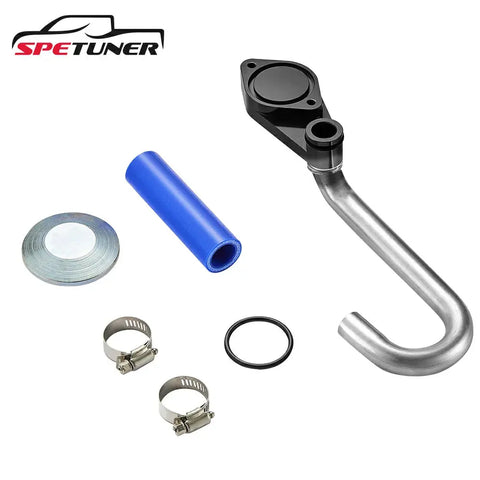
Designed for 2003-2007 Ford 6.0L Powerstroke off-road and competition trucks. Removes the factory EGR cooler and valve as common failure points, reduces intake carbon, lowers EGT, and supports cleaner airflow and improved reliability.
Buy NowEGR Delete vs. Upgraded EGR Cooler
| Feature | EGR Delete | Upgraded EGR Cooler |
|---|---|---|
| Stops EGR cooler failure | Yes | Reduces the risk |
| Reduces intake soot | Yes | No |
| Requires tuning | Yes | Usually no |
| Suitable for street use | No | Yes, when compliant |
| Best use | Off-road and competition | Daily driving and towing |
What Should You Check Before an EGR Delete?
Check the Oil Cooler
The oil cooler and EGR cooler work through the same cooling path. A restricted oil cooler can reduce coolant flow and increase heat.
Monitor engine coolant temperature and engine oil temperature after the truck is fully warm. A large and steady temperature gap can point to oil cooler restriction.
Check for Head-Gasket Problems
A leaking EGR cooler and failed head gaskets can create similar symptoms.
Watch for:
- Coolant pushed from the degas bottle
- A hard upper radiator hose
- Cooling-system pressure after a cold start
- Coolant loss under heavy load
- Repeated overheating
Check the Turbo
Sticking turbo vanes can cause low boost, poor throttle response, smoke, and weak towing power. An EGR delete will not repair the turbo.
Check Fuel Pressure and Injectors
Low fuel pressure can damage injectors. Weak injectors can also cause smoke, rough running, and low power.
Scan All Trouble Codes
Record all active, pending, and history codes before clearing them. EGR, turbo, injector, FICM, and high-pressure oil codes can point to different problems.
How to Delete the EGR on a 6.0 Powerstroke
A 6.0 Powerstroke EGR delete is a moderate to advanced job. It requires access to the turbo, intake manifold, EGR cooler, coolant hoses, and related hardware.
The basic process includes:
- Disconnect both batteries.
- Drain the engine coolant.
- Remove the intake tubing and related engine covers.
- Remove the turbo and intake components needed for access.
- Remove the EGR valve, cooler, and related piping.
- Install the delete components, gaskets, and coolant routing parts.
- Reinstall the intake and turbo system.
- Refill and bleed the cooling system.
- Check for coolant, boost, and exhaust leaks.
- Load the correct professional ECU calibration.
Before starting, read the complete 6.0L Powerstroke EGR delete installation guide. It explains the component locations, removal order, installation steps, and final checks.
Do You Need a Tune After a 6.0 Powerstroke EGR Delete?
Yes. ECU tuning is required after an EGR delete.
The factory ECU monitors EGR valve position, EGR flow, and related sensor data. Removing the system without a correct calibration can cause:
- Check engine lights
- P0401, P0402, P0404, or P0405 codes
- Rough idle
- Reduced power
- Poor throttle response
- Incorrect turbo control
A professional tune also helps match fueling, timing, boost, and transmission behavior to the new engine setup.
Common Problems After a 6.0 Powerstroke EGR Delete
Check Engine Light
A warning light usually means the ECU still sees missing or incorrect EGR data. The truck needs the correct calibration and a complete code scan.
Coolant Leaks
Leaks can come from loose clamps, damaged O-rings, poor hose routing, or improperly sealed delete parts.
Boost Leaks
The intake and turbo system must be removed during many installations. A loose boot or damaged seal can cause a hiss, low boost, smoke, and weak acceleration.
Rough Idle
A rough idle may come from incorrect tuning, injector problems, air in the fuel system, or a connector that was left loose during reassembly.
Overheating
Overheating after the delete can point to trapped air, low coolant, a restricted oil cooler, a weak water pump, a bad degas cap, or another cooling-system fault.
High EGT
A correct EGR delete lowers EGT. High EGT after installation can point to excess fueling, low boost, a boost leak, turbo trouble, or poor calibration.
How Does an EGR Delete Affect Towing?
A correctly installed EGR delete can improve towing performance by lowering EGT, reducing intake heat, and improving airflow.
This can help the truck maintain power on long grades and under heavy load.
For towing, monitor:
- Engine coolant temperature
- Engine oil temperature
- Exhaust gas temperature
- Transmission temperature
- Boost pressure
- Fuel pressure
A delete does not replace a healthy cooling system, turbo, transmission, fuel system, or set of injectors.
Does an EGR Delete Improve Horsepower?
Yes, an EGR delete can improve engine performance by reducing exhaust restriction, lowering intake heat, and keeping the intake system cleaner.
The largest difference is often seen on trucks that already have carbon buildup, a sticking EGR valve, or poor airflow.
The final power gain also depends on the tune, turbo condition, injectors, fuel pressure, exhaust system, and overall engine health.
Does an EGR Delete Improve MPG?
Yes, many 6.0 Powerstroke owners report better fuel economy after an EGR delete.
Cleaner airflow and more efficient combustion help the engine use fuel more effectively.
For an accurate comparison:
- Track fuel use over several full tanks.
- Use the same route and similar driving speed.
- Compare the same trailer or load.
- Calculate MPG by hand instead of using only the dashboard display.
Does an EGR Delete Improve Engine Life?
Yes, a correct EGR delete can improve engine life by reducing carbon buildup, removing the EGR cooler failure point, lowering EGT, and reducing heat stress.
Long-term reliability still depends on:
- Correct ECU tuning
- Healthy oil cooler
- Good coolant flow
- Correct oil and filter service
- Stable fuel pressure
- Healthy injectors
- Proper turbo operation
Should You Buy a Used 6.0 Powerstroke With an EGR Delete?
A deleted truck can be a good purchase, but the delete alone does not prove the engine is healthy.
Before buying, check:
- Who installed the delete kit
- Which tune is installed
- Whether the original emissions parts are included
- Engine oil and coolant temperatures
- Cold-start behavior
- Injector balance and FICM voltage
- Cooling-system pressure
- Turbo boost and vane operation
- Local inspection and registration rules
For a complete inspection list, read what you need to know before buying a used 6.0L Ford Powerstroke.
Street-Legal Alternatives to an EGR Delete
Owners who drive on public roads can improve reliability without removing the emissions system.
Install an Upgraded EGR Cooler
A reinforced EGR cooler is built to handle heat and coolant pressure better than the factory part.
Replace a Restricted Oil Cooler
A healthy oil cooler helps maintain coolant flow to the EGR cooler and controls engine oil temperature.
Clean the EGR Valve and Intake
Cleaning removes carbon that can restrict airflow and cause EGR valve problems. It is a temporary fix, but it can restore normal operation.
Use Legal Intake and Exhaust Parts
CARB EO-approved intake and exhaust parts can improve airflow while keeping the truck street compliant where required.
Monitor ECT and EOT
A digital monitor helps catch oil cooler restriction before it damages the EGR cooler or creates a larger cooling problem.
Conclusion
A 6.0 Powerstroke EGR delete is worth it for many off-road and competition truck owners.
It removes the EGR cooler and valve as failure points. It also lowers EGT, reduces carbon buildup, improves airflow, supports better fuel economy, and reduces future EGR-related repairs.
The delete must be installed correctly and matched with professional ECU tuning. The oil cooler, cooling system, turbo, injectors, head gaskets, and fuel system should also be checked.
For a street-driven truck, an upgraded EGR cooler and a healthy oil cooler are the safer legal choice. For a lawful off-road build, a quality EGR delete can be one of the most useful reliability upgrades for the 6.0 Powerstroke.
Frequently Asked Questions
Q1: Is a 6.0 Powerstroke EGR delete worth it?
A1: Yes. It is worth it for many off-road and competition truck owners because it removes EGR cooler failures, reduces intake carbon, lowers EGT, and improves reliability.
Q2: Is an EGR delete legal in the United States?
A2: It is not legal for a truck used on public roads. Federal law and many state laws prohibit removing or disabling factory emissions equipment.
Q3: Does a 6.0 Powerstroke need a tune after an EGR delete?
A3: Yes. Professional ECU tuning is required to prevent EGR fault codes and to control fueling, boost, timing, and drivability.
Q4: Will an EGR delete stop white smoke?
A4: It will stop white smoke caused by a leaking EGR cooler. The engine should still be checked for head-gasket, injector, turbo, and other cooling-system problems.
Q5: Does an EGR delete lower EGT?
A5: Yes. Removing hot exhaust gas from the intake lowers heat and helps reduce exhaust gas temperature.
Q6: Does an EGR delete improve fuel economy?
A6: Yes. Many owners report improved MPG because of cleaner airflow, lower heat, and more efficient combustion.
Q7: How much horsepower does a 6.0 EGR delete add?
A7: The gain depends on carbon buildup, the ECU tune, turbo condition, injectors, exhaust flow, and the overall engine setup.
Q8: Can an EGR delete prevent head-gasket failure?
A8: It reduces heat and EGR-system pressure problems, but it does not repair head gaskets that are already damaged.
Q9: What codes appear after an EGR delete without tuning?
A9: Common codes include P0401, P0402, P0404, and P0405. The truck may also show a check engine light or reduced performance.
Q10: What is the best legal alternative to an EGR delete?
A10: Use a reinforced EGR cooler, a healthy oil cooler, clean coolant, regular EGR cleaning, and legal intake or exhaust upgrades.
Q11: Can I tow after a 6.0 Powerstroke EGR delete?
A11: Yes, for lawful off-road use. Monitor EGT, ECT, EOT, boost, fuel pressure, and transmission temperature when towing.
Q12: Should I delete the EGR before checking the oil cooler?
A12: No. Check the oil cooler and cooling system first. A restricted oil cooler can still cause high oil temperature after the EGR system is removed.