The 2.8L "Baby" Duramax is a torque monster.
You'll find it in the 2016-2022 Chevy Colorado and GMC Canyon. It tows great. It easily pushes 30 MPG on the highway.
But there is a dark side.
Despite its bulletproof iron block, this engine has a specific set of problems. Most of them are emissions-related.
From frozen DEF heaters to clogged EGR valves, this engine literally chokes on its own factory emissions equipment.
In this guide, I will break down the most common 2.8 Duramax problems.
You'll learn the exact symptoms to watch out for. And more importantly, I’ll show you the practical solutions (including permanent fixes) to keep your truck out of limp mode.
Let's dive in.
Quick Answer: What Are the Most Common 2.8 Duramax Problems?
Short on time? Here are the top culprits plaguing the 2.8L Duramax:
- DEF System Failures: Freezing heaters and fluid crystallization.
- EGR Clogging: Sticky carbon sludge is choking the engine.
- DPF Clogging: Failed regens from short city driving.
- NOx Sensor Malfunctions: Fragile sensors are causing emission codes.
- Fuel Injector Issues: Extreme sensitivity to bad fuel.
- Transmission Shudder: Often mistaken for an engine misfire.
- Timing Belt Snapping: Total engine failure if ignored past 150k miles.
(Looking for a deep dive into engine longevity? Check out our complete Duramax Lifespan Guide.)
Is the 2.8L Baby Duramax Reliable?
Yes and no.
The core architecture of the 2.8L Duramax is incredibly robust. The engine block and rotating assembly are built to last hundreds of thousands of miles.
So, why the bad reputation?
The complaints almost entirely stem from the bolt-on emissions systems. The DPF, EGR, and SCR systems require strict maintenance and specific driving habits.

If you use this truck for quick 5-minute trips to the grocery store, it will become notoriously unreliable. Diesels need to run hot.
What Years of 2.8 Duramax Should You Avoid?
No year is completely immune to emissions gremlins.
However, you should be extremely careful with 2016 to 2018 models.
These early years are highly prone to early DEF heater failures and terrible transmission shudder issues. GM eventually issued technical service bulletins (TSBs) and updated parts, making the 2019-2022 models slightly more refined.
[Exclusive Analysis] The 2.8L "Soot Death Spiral."
Most mechanics treat Duramax problems as isolated incidents.
They aren't.

Our deep dive into the LWN engine reveals that these failures are connected. We call it the "Soot Death Spiral". Here is exactly how one failure triggers the next:
-
Short Trips: Stop-and-go driving prevents high exhaust temperatures.
-
EGR Sludge: The EGR valve recirculates "wet" soot into the intake. It creates a thick, black sludge.
-
DPF Choke: The engine suffocates, runs rich, and creates more soot. The DPF fills up fast.
-
The Washout: The truck enters constant "Active Regen" to clear the DPF. Excess diesel washes past the piston rings, diluting your engine oil.
-
The Kill: Diluted oil loses its lubricity. Your turbocharger bearings and internal engine parts fail prematurely.
The Takeaway: A clogged DPF isn't just bad luck. It is the final stage of a suffocating engine.
Top 8 Most Common 2.8 Duramax Problems
Now that you know how the system fails, let’s look at the specific parts that break.
1. DEF System (SCR) Failures
This is arguably the #1 complaint from Colorado and Canyon owners.
- Symptoms: "Exhaust Fluid Quality Poor" warnings, Check Engine Light (CEL), and the dreaded Limp Mode countdown.
- Causes: The DEF tank heater burns out in cold climates when the fluid freezes.
- The Fix: Replacing the DEF heater or reservoir assembly. (Average dealer cost: $1,000 - $1,500).
2. EGR Valve & Cooler Clogging
[Insert Image: A side-by-side comparison of a clean EGR valve vs. a severely carbon-clogged EGR valve]
As explained in the "Soot Death Spiral," the EGR routes dirty exhaust back into the intake.
- Symptoms: Rough idling, noticeable power loss, and terrible throttle response.
- The Fix: Manual removal and deep cleaning. Or, an off-road bypass.
3. DPF Clogging & Regeneration Issues
The Diesel Particulate Filter (DPF) traps soot. Without long, hot highway drives, it can't burn the soot off.
- Symptoms: Terrible MPG, loud cooling fans after shutting off the truck, and constant dashboard warnings.
- The Fix: A forced stationary regeneration at the dealership.
4. NOx Sensor Failures
These sensors live in a harsh, soot-filled environment. They fail constantly.
- Symptoms: Immediate CEL and DEF-related errors.
- The Fix: Replacement of the sensors (they usually need to be replaced in pairs).
5. Glow Plug & Cold Start Problems
If you live in a cold-weather state, your glow plug modules will degrade.
- Symptoms: Extended cranking, rough idle on cold mornings, and excessive white smoke.
- The Fix: Test resistance and replace faulty glow plugs to reduce initial soot output.
6. The 6L50 Torque Converter Shudder
While technically a transmission flaw, it feels exactly like a 2.8L engine misfire.

- Why it happens: The 6L50 torque converter judders severely under light acceleration.
- The Fix: A complete transmission fluid flush using updated Mobil 1 synthetic fluid.
7. Turbocharger Problems (VGT Issues)
Heavy soot output coats the Variable Geometry Turbo (VGT) vanes, causing them to stick.
- Symptoms: Sudden loss of power, terrible turbo lag, or a P0299 underboost code.
- The Fix: Cleaning the turbo vanes or replacing the sticking actuator.
8. Timing Belt Failure (The Silent Killer)
Unlike the massive 6.6L Duramax, your 2.8L uses a rubber timing belt.
- The Danger: The LWN is an interference engine. If the belt snaps, pistons smash into valves. Total engine failure.
- The Fix: Preventive replacement strictly at the 150,000-mile mark. No exceptions.
How To Break the Death Spiral: Deleting and Tuning
What if you didn't have to deal with clogged DPFs or frozen DEF heaters ever again?
If you use your Chevy Colorado or GMC Canyon strictly for off-road use, competition, or driving on private land, there is a permanent solution.
The most effective, scientifically proven way to maximize the lifespan of the 2.8L Duramax is a complete emissions delete.
By physically removing the restrictive DPF and blocking the EGR system, you stop the engine from ingesting its own toxic soot.
The immediate benefits include:
- Zero risk of Limp Mode.
- Restored horsepower and massive torque gains.
- A significant boost in fuel economy (MPG).
- Spotless intake manifolds and clean engine oil.
To do this safely and correctly, you need precision-engineered hardware.
We highly recommend the GMC Canyon 2.8 Duramax Delete Kit to fix 2.8 Duramax DPF/EGR issues.
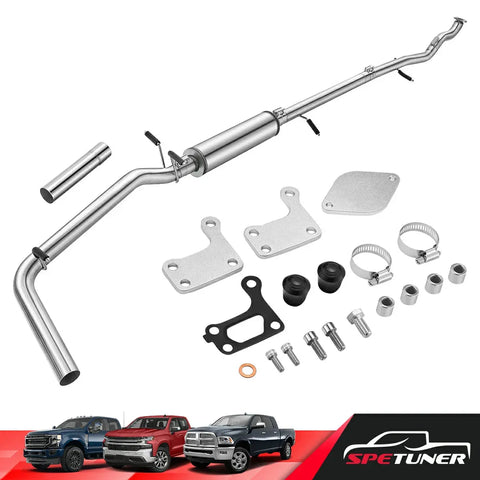
Designed specifically for the 2016–2019 2.8L Duramax LWN engine in the Chevy Colorado and GMC Canyon. This complete kit includes a 3" Turbo-Back pipe, EGR block-off plates, and all hardware needed to eliminate factory restrictions and boost off-road performance.
Conclusion
The 2.8L Duramax is a brilliant piece of engineering. But it is hidden underneath a fragile web of emissions technology.
DEF failures and DPF regeneration issues are incredibly common.
But they are manageable.
You have two choices: follow a strict, proactive maintenance schedule, or opt for a complete off-road delete kit to permanently solve the problem. Either way, keeping the soot out of your engine is the secret to hitting that 200,000-mile mark.
FAQ
Q1: How long will a 2.8 Duramax last?
A1: With meticulous maintenance, it can easily last 200,000 to 300,000 miles. The iron block is highly durable. But high mileage depends on timely timing belt changes and managing the emissions systems.
Q2: Does the 2.8 Duramax have a timing belt or a timing chain?
A2: It uses a rubber timing belt. GM strictly recommends replacing it every 150,000 miles. Because it is an interference engine, a snapped belt causes catastrophic internal damage.
Q3: Why does my 2.8 Duramax keep going into "Limp Mode"?
A3: The most common cause is an emissions system failure. A severely clogged DPF, a stuck EGR valve, or a malfunctioning DEF system will limit power to prevent engine damage.
Q4: Is deleting the 2.8 Duramax worth it?
A4: For off-road and competition use, yes. It permanently resolves DPF clogging, EGR sludge, and DEF heater failures while improving horsepower. (Note: Deleting emissions equipment violates EPA regulations for on-highway vehicles).
Q5: Why did my DEF heater fail in the winter?
A5: This is a widespread defect on 2016-2018 models. Diesel Exhaust Fluid (DEF) freezes in extreme cold, and the factory heaters burn out trying to thaw the solid fluid.
Q6: How often should I change the fuel filter on the 2.8 Duramax?
A6: Mechanics strongly recommend changing the fuel filter every 15,000 to 20,000 miles. The high-pressure fuel system is sensitive; dirty fuel quickly destroys the injection pump.
Q7: Can I use the 2.8 Duramax for short daily commutes?
A7: No. Modern diesels require long, hot highway drives to initiate DPF regeneration. Short trips prevent the exhaust from getting hot, leading to rapid soot accumulation.
Q8: What type of oil is required for the 2.8L Duramax?
A8: You must use a fully synthetic low-SAPS oil. Early models require dexos2™ 5W-30, while newer models specify dexosD™ 0W-20. Using standard oil will clog your DPF.
Q9: What are the signs of carbon buildup in the intake manifold?
A9: Carbon soot mixes with oil vapors to create sticky sludge. Signs include rough idling, sluggish acceleration, decreased fuel economy, and frequent Check Engine Lights.
Q10: Does the Chevy Colorado 2.8 diesel have transmission shudder problems?
A10: Yes. The 6L50 6-speed automatic is notorious for severe shuddering during shifting. The standard fix is a complete transmission fluid flush using updated Mobil 1 synthetic fluid.

Lars
Diesel Performance Engineer | 15+ Years EXPERIENCE
"Empower Your Beast: Run Cooler, Pull Harder, Last Longer."