Intercooler Piping Kit Guide: What Comes in a Diesel Intercooler Pipe Kit?
Quick Answer:
A diesel intercooler piping kit replaces weak factory plastic pipes, rubber boots, and light-duty clamps with stronger charge-air parts that hold boost under heat and load. Most kits include a hot-side pipe from the turbo to the intercooler, a cold-side pipe from the intercooler to the intake, reinforced silicone boots, T-bolt clamps, seals, hardware, and sometimes a Duramax Y-bridge. Upgrade to a full kit if your truck has low boost, hissing under throttle, black smoke, oil around the couplers, repeated boot blow-offs, or a loud pop followed by sudden power loss. A quality kit should use mandrel-bent aluminum piping, bead-rolled pipe ends, 4-ply or 5-ply silicone couplers, correct sensor ports, and exact platform fitment for your Powerstroke, Duramax, or Cummins. Most direct-fit intercooler pipe kits do not need tuning as long as the sensor locations, pipe routing, and emissions-related layout stay factory-correct.
Legal Notice: Some diesel modifications may not be legal for public road use in many areas. Intercooler pipes handle the air entering your engine. Because regulations vary, always review your federal, state, and local vehicle laws before altering any parts under the hood. Ensure your modifications comply with local emissions guidelines if you operate your truck on public roads.
What Is an Intercooler Piping Kit?
An intercooler piping kit is a set of heavy-duty tubes and connectors. They guide pressurized, hot air from your turbo, through the front intercooler, and straight into your diesel engine. On hard-working Duramax, Cummins, and Powerstroke engines, this air path is everything.
If your truck cannot hold boost pressure, you will lose horsepower, burn more fuel, and see your Exhaust Gas Temperatures (EGTs) shoot up dangerously high. Factory pipes are often made of cheap plastic or thin rubber. Over time, extreme engine heat and high boost pressure cause them to split wide open. An aftermarket piping kit replaces these weak spots with tough, mandrel-bent metal and reinforced couplers that will not burst under pressure.
What Usually Comes in a Diesel Intercooler Pipe Kit?
When you unbox a high-quality aftermarket piping kit, you will find these essential parts:

| Kit Component | What It Does | What to Look For |
|---|---|---|
| Hot Side Intercooler Pipe | Carries hot, compressed air out of the turbocharger down to the intercooler. | Must handle extreme heat without warping or holding onto heat. |
| Cold Side Intercooler Pipe | Feeds cooled, dense air from the intercooler back up into the engine's intake. | This is the #1 failure point on stock trucks. Metal upgrades are highly recommended. |
| Silicone Boots and Couplers | Connect the metal pipes together and absorb engine flexing and vibration. | Look for 4-ply or 5-ply reinforced silicone. Cheap rubber will rot from oil residue. |
| Heavy-Duty T-Bolt Clamps | Lock the silicone boots onto the pipes so they do not blow off under load. | Standard worm-gear clamps slip. Spring-loaded T-bolt clamps offer the tightest seal. |
| O-Rings and Hardware | Seals connections tightly against factory flanges, especially on Ford trucks. | Make sure the kit includes new, fresh seals so you do not have to reuse old, leaky ones. |
| Y-Bridge / Intake Bridge | Splits incoming cold air into both sides of the cylinder head on V8 diesel layouts. | Mainly used for Duramax engine upgrades; not required for straight-6 Cummins trucks. See our Duramax Y-bridge upgrade guide for full details. |
Hot Side vs. Cold Side Intercooler Piping: What's the Difference?
Your charge-air system has two distinct halves. While both can leak, they fail for different reasons. Knowing how they work helps you find leaks before you get stranded on the side of the road.

| Pipe Location | The Biggest Issues | Truck Owner Warning Signs |
|---|---|---|
| Hot Side Pipe | Intense turbo heat breaks down the factory rubber. Constant engine twisting can loosen the clamps. | Oily residue around the turbo outlet, slow boost build-up, or a soft whistling sound under the hood. |
| Cold Side Pipe | The brittle factory plastic splits completely in half under heavy towing or high boost levels. | A loud "POP" sound while accelerating, followed by instant power loss, a Check Engine Light (CEL), and black smoke. |
For a deeper breakdown of how each half behaves under load, read our cold side vs. hot side intercooler pipe comparison guide.
When Should You Upgrade Your Truck's Piping Kit?
Keep an eye out for these common warning signs that your stock pipes are failing:
- Your Boost Gauge Drops: If your truck feels sluggish and your dashboard boost gauge reads lower than normal, you have a leak.
- You Hear a Hissing Sound: A distinct whistle or rushing air noise under heavy throttle means valuable boost pressure is escaping.
- Your Stock Plastic Pipe Is Oil-Soaked: PCV oil vapor naturally gets into the charge pipes. Over time, this oil softens factory rubber and plastic, causing them to rot and crack.
- You Keep Blowing Boots Off: If your truck spits a boot off every time you hook up a heavy trailer, your stock smooth pipes and cheap clamps cannot handle the load.
- You Want Reliable Towing Performance: Upgrading to a metal kit gives you peace of mind. You can climb steep highway grades without worrying about a sudden roadside breakdown.
Still unsure whether to repair or replace? Our OEM vs. aftermarket intercooler pipe guide walks through exactly what you are giving up by staying with factory parts.
Pro Tip from Truck Owners: When installing your new kit, spray a little aerosol hairspray or brake cleaner inside the silicone boot before clamping it down. This cleans off any grease and helps the boot tack-weld itself to the metal pipe so it never blows off again.
Fitment Guide: Powerstroke, Duramax, and Cummins
Diesel intercooler piping is never one-size-fits-all. A kit built for a Ford 6.7L Powerstroke will not line up with a GM 6.6L Duramax or a Ram 6.7L Cummins. Even changing the model year by just one year can completely change how the sensors and flanges connect.
Ford Powerstroke (6.0L, 6.4L, 6.7L)
Pay close attention to the cold side pipe. The factory quick-disconnect clips on the 6.7L are notorious for leaking. They benefit greatly from a solid aluminum replacement kit with beaded pipe ends that lock the couplers in place permanently.
GM Duramax (LB7, LLY, LBZ, LMM, LML, L5P)
Check if you need a kit with a Y-bridge. Early generations use restrictive factory bridges that strangle airflow. An all-in-one pipe and Y-bridge kit is a smart upgrade. See our stock vs. high-flow Duramax Y-bridge comparison to find the right fit for your generation.
Ram Cummins (5.9L, 6.7L)
Watch out for differences in the passenger-side grid heater layouts and throttle valve connections. These change depending on your exact model year. Always confirm sensor port placement matches your factory configuration before ordering.
What to Look For Before Buying a Kit
Do not just buy the cheapest kit online. Check these critical product specs first:
- Material: Choose mandrel-bent aluminum or heavy-duty stainless steel. Mandrel bending keeps the pipe perfectly round through every curve, ensuring smooth, fast airflow.
- Boot Quality: Ensure the boots are made of high-temp silicone with multiple layers of mesh reinforcement to prevent flexing under high pressure.
- Beaded Pipe Ends: High-quality metal pipes feature a rolled lip or bead on the ends. This raised edge gives the T-bolt clamp something to bite into, stopping the boot from blowing off.
- Sensor Ports: Make sure the new pipe includes pre-welded bungs for your factory MAP (Manifold Absolute Pressure) sensor or temperature sensors so you do not get any error codes.
For a complete spec-by-spec breakdown of what separates a good kit from a cheap one, see our diesel intercooler pipe buying guide.
Top SPETUNER Intercooler Pipe Kits by Platform
1. SPETUNER Intercooler Pipe Kit - 2017-2024 Ford 6.7L Powerstroke
Engineered for F-250, F-350, and F-450 Super Duty trucks with the 6.7L Powerstroke diesel, this kit replaces the notoriously leak-prone factory cold side pipe with a direct-fit aluminum upgrade. Every sensor bung is welded in the stock location, and the beaded pipe ends pair with 4-ply silicone boots and T-bolt clamps for a leak-free seal.

Direct-fit aluminum replacement with beaded pipe ends, 4-ply reinforced silicone boots, and heavy-duty T-bolt clamps. All sensor bungs are welded in factory-correct locations for a straightforward install.
2. SPETUNER Intercooler Pipe Kit - 2011-2016 Duramax LML
Built for Chevrolet Silverado and GMC Sierra 2500HD/3500HD trucks with the 6.6L Duramax LML engine. Mandrel-bent aluminum piping replaces the factory plastic cold side pipe, the single most common failure point on LML trucks. Reinforced silicone couplers absorb engine movement without leaking.

Mandrel-bent aluminum piping with reinforced silicone couplers for a leak-free, direct-fit upgrade. Replaces the brittle factory plastic cold side pipe that is the most common boost leak source on LML trucks.
3. SPETUNER Intercooler Pipe Kit - 2013-2018 Ram 6.7L Cummins
Precision-fit aluminum pipes for Dodge Ram 2500 and 3500 trucks with the 6.7L Cummins diesel. Fresh O-rings and heavy-duty T-bolt clamps are included. Sensor port placement matches factory specifications for hassle-free installation without modifications.

Precision-fit aluminum pipes with fresh O-rings and heavy-duty T-bolt clamps. Correct sensor port placement supports hassle-free installation, and the kit is built to handle the high boost levels Cummins engines produce under load.
4. SPETUNER 3-Inch Cold Side Intercooler Pipe and Y-Bridge Kit - 2006-2010 Duramax LBZ/LMM
For 2006-2010 Duramax LBZ and LMM owners, this kit replaces restrictive factory parts with smooth 3-inch aluminum piping and triple-reinforced silicone couplers. It is built for the LBZ and LMM platforms where the cold side pipe and Y-bridge can become a major airflow restriction or boost-leak point.
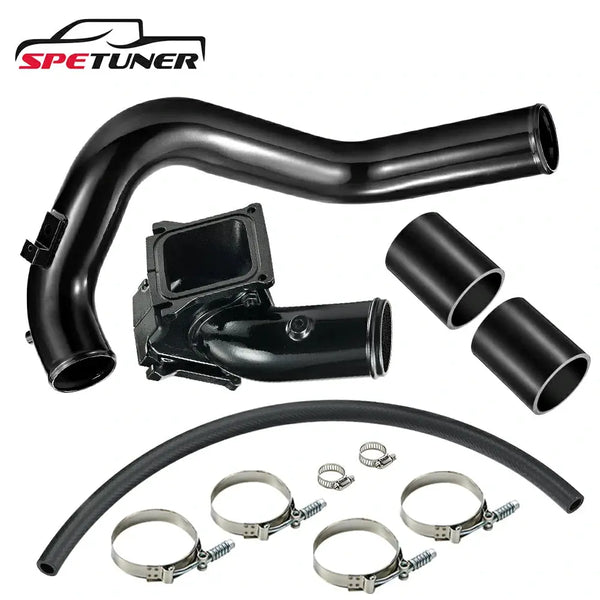
Smooth 3-inch aluminum cold side piping, high-flow Y-bridge hardware, triple-reinforced silicone couplers, and T-bolt clamps help remove factory airflow restrictions and reduce boost-leak risk on LBZ and LMM Duramax trucks.
Shop All Intercooler Pipe Kits
Explore SPETUNER's full intercooler pipe collection, including direct-fit kits for Ford Powerstroke, GM Duramax, and Ram Cummins trucks. Every kit is built around platform-specific fitment with pipes, reinforced boots, and clamps for a complete, leak-free install.
Compliance and Professional Installation
Intercooler pipes handle the air entering your engine. Because regulations vary, always review your federal, state, and local vehicle laws before altering any parts under the hood. Ensure your modifications comply with local emissions guidelines if you operate your truck on public roads.
While many truck owners love DIY garage projects, we highly recommend professional installation. This is especially true if you are dealing with rusted factory bolts, aftermarket turbo setups, or tight clearances around your engine bay.
References
- Garrett Motion: "Intercooler and Charge Air Cooling Technical Overview." Available from Garrett Motion Performance Catalog.
- Banks Power: "Charge-Air Cooling and Intercooler System Design." Available from Banks Power.
- Environmental Protection Agency: "Tampering and Aftermarket Defeat Devices." Available from EPA Vehicle Enforcement.
- General Motors: "Duramax 6.6L Turbo-Diesel Engine Technical Specifications." Available from GMC Sierra HD Diesel.
- Ford Motor Company: "6.7L Powerstroke Turbo Diesel Specifications." Available from Ford Super Duty.
- SAE International: "Charge Air Cooling for Diesel Engines - Technical Paper Series." Available from SAE Technical Papers.
FAQ
Q1: Will an intercooler piping kit give my diesel truck more horsepower?
A1: By itself, a piping kit mainly restores lost power by curing hidden boost leaks. Factory plastic pipes and rubber boots degrade over time and leak boost pressure, which reduces horsepower without always triggering a check engine light. A sealed metal kit helps recover the power your engine was already supposed to make, and it also supports higher horsepower tuning by improving airflow and boost retention.
Q2: What is the difference between an intercooler pipe and a charge pipe?
A2: They are two names for the same type of part. Diesel truck owners and mechanics use both terms to describe the pipe that carries pressurized, charged air from the turbocharger through the intercooler and into the engine's intake manifold. Whether someone says intercooler pipe or charge pipe, they are usually talking about the same charge-air system plumbing.
Q3: Can I just replace the broken factory boot, or should I buy a whole kit?
A3: If your truck still has plastic factory pipes, replacing only the boot is usually a temporary fix. The aged pipe has already been through years of heat cycling and may crack next. A full metal kit fixes the pipes, boots, and clamps together, which is especially useful on trucks with higher mileage, towing use, or repeated boot blow-offs.
Q4: Is aluminum better than stainless steel for intercooler pipes?
A4: For most street-driven and tow-use diesel trucks, mandrel-bent aluminum is the preferred material because it is lightweight, resists corrosion, and sheds heat quickly. Stainless steel can be stronger for extreme high-boost or race applications, but it adds weight and holds more heat. Match the material to your truck's power level, duty cycle, and climate.
Q5: Do I need a computer tune after installing an intercooler pipe kit?
A5: No, most standard replacement intercooler pipe kits do not require tuning. A direct-fit kit keeps the MAP sensor and temperature sensor locations where the ECM expects them, so you can bolt the kit on and drive. A tune may be needed only when sensor locations, pipe diameter, turbo layout, or airflow modeling changes significantly.
Q6: How do I know if my intercooler pipe is leaking?
A6: Common signs include lower-than-normal boost, sluggish throttle response, hissing or whistling under load, oil residue around couplers, black smoke, or a sudden pop followed by power loss. Inspect pipe ends, boots, clamps, sensor ports, and intercooler connections before assuming the problem is the turbo or the tune.
Q7: How long does it take to install an intercooler piping kit?
A7: A standard cold side pipe replacement often takes 1 to 2 hours for a skilled DIY owner with basic hand tools. A full hot and cold side kit can take 2 to 4 hours depending on access, rusted fasteners, battery layout, aftermarket intakes, and turbo-side clearance. Budget more time or professional labor if the truck has tight engine bay packaging or modified hardware.
Q8: Will an intercooler pipe upgrade void my warranty?
A8: An aftermarket intercooler pipe can create warranty risk, but it is usually lower risk than tuning because it is a passive airflow component. If the pipe is installed correctly and does not cause a leak, it is harder to connect it to an unrelated engine failure. However, if the pipe leaks, rubs through, or causes an overboost or underboost condition, related damage may not be covered.
Q9: Do intercooler pipe kits fit with aftermarket turbos?
A9: It depends on the kit and turbo combination. Most standard replacement kits are designed around the factory turbo outlet, intercooler inlet, and sensor locations. If an aftermarket turbo changes the outlet flange, angle, size, or location, the stock-fit pipe may not line up. Confirm flange style, pipe diameter, and coupler size before ordering.
Q10: What size intercooler piping do I need, 2.5-inch or 3-inch?
A10: For most stock-turbo trucks used for daily driving and towing, 2.5-inch piping provides enough flow without adding unnecessary volume. A 3-inch pipe can help higher-horsepower trucks, larger turbo setups, compound turbo systems, or builds that move much more air. Match pipe size to the engine, turbo, intercooler, and power goal instead of choosing the largest pipe by default.

Lars
Diesel Performance Engineer | 15+ Years EXPERIENCE
"Empower Your Beast: Run Cooler, Pull Harder, Last Longer."